When you’re cultivating tomatoes, capsicum or cucumber using Growing Media used in Greenhouse under glass, your choice of substrate can make or break the crop. This post walks you through coco coir in grow bags—what makes it excellent for greenhouse cultivation, and why growers across the Netherlands, USA, Canada, Mexico, Germany (and beyond!) are choosing it more often. Let’s get into it.
Why coco coir shines in greenhouse growing media used in greenhouse cultivation
Coco coir basics—and why it’s a top growing medium
Coco coir comes from the fibrous husk of coconuts—and despite being organic, it behaves like a well‑engineered substrate. Water‑holding? About 40% by volume. Air‑filled porosity? Roughly 13% or more depending on grade. It’s low density, holds shape, and lasts multiple seasons if cleaned and sterilized properly.
Leach salts, add lime, manage pH
Sri Lankan and Indian coir often has high potassium or chloride levels, so proper leaching before planting is key. Many growers add dolomitic lime to balance calcium and magnesium needs.
Air‑filled porosity matters
Studies show that substrates with air‑filled porosity around 28–33% boost root growth, fruit set, and yield in tomato crops grown under greenhouse conditions.
How grow bags fit into greenhouse cultivation
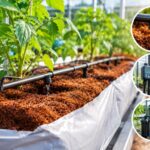
Grow bags filled with coco coir are widely used in greenhouse systems, especially in Europe and North America. They’re designed to give each plant just enough room and balanced moisture—without overwatering or drowning roots. You lay the bag flat, cut planting holes, insert seedlings: minimal fuss, maximal yield.
Benefits for tomatoes, capsicum & cucumber
Better yield
A Mexico-based trial comparing coco coir vs sawdust and volcanic sand found yields of cherry tomatoes at 12–13 kg/m²—higher than sand alone (around 9–10 kg/m²).
Root health & water use
Excellent drainage + moisture retention helps avoid root rot while keeping steady hydration. Especially important for capsicum and cucumber, which require consistent moisture without waterlogging.
Reusability and sustainability
Unlike peat, coco coir is renewable and reusable with sterilisation—making it eco‑friendly and cost-effective long term. That’s appealing in markets like Germany and Netherlands where sustainability matters.
Mix with rice straw or compost?
Recent studies on cucumber show rice straw (alone or in blends) sometimes outperform pure coco‑peat in yield and water productivity Nature. But coir remains a reliable staple, especially in grow bags and hydroponic systems.
Best practices for greenhouse use
- Choose the right particle size: chips or medium fiber work well in grow bags. Dust is less good for air flow.
- Test EC and pH before planting. Flush salts if needed.
- Add lime or magnesium supplements—especially dolomitic lime.
- Sterilise between crops if reusing bags. Prevent pathogens like Leucocoprinus fungus.
- Monitor watering carefully. Irrigate based on substrate moisture, not fixed schedule.
- Use drip irrigation or ebb‑and‑flow systems to keep nutrients balanced.
You know what? These steps feel simple—but they matter. Get them right, and you avoid common stumbling blocks like nutrient lock‑out or oxygen starvation.
FAQs (answering likely search snippets)
Q: What makes coco coir better than peat or rockwool?
A: Coco offers sustainability, good water-air balance, minimal compaction, and it’s renewable—unlike peat. Compared to rockwool, coir is biodegradable and easier to handle.
Q: Is coco coir good for cucumbers and capsicum?
A: Absolutely—grow bag systems using coco coir consistently deliver healthy yields and fruit quality for both crops when pH and nutrients are managed.
Q: Can I mix coir with compost or straw?
A: Yes. Mixing with compost or rice straw can improve microbial content and nutrient availability—but be cautious of stability, EC, and nitrogen drawdown effects.
Q: Where can I buy quality coco coir grow bags?
A: At Coco Labs, we produce premium coir grow bags tailored for tomato, capsicum and cucumber growers worldwide—from Sri Lanka to Canada, Mexico, USA, Germany, Netherlands. Learn more at our site.
When you’re looking at growing media used in greenhouse cultivation, coco coir grow bags hit the sweet spot: sustainable, tunable, forgiving—yet powerful. Whether you’re growing greenhouse tomatoes in Netherlands or capsicum in Mexico, the key is proper preparation and crop-specific nutrient management. Curious to boost your yield and simplify your system? Check out Coco Labs or dive into our Grow Bag guide to get started.