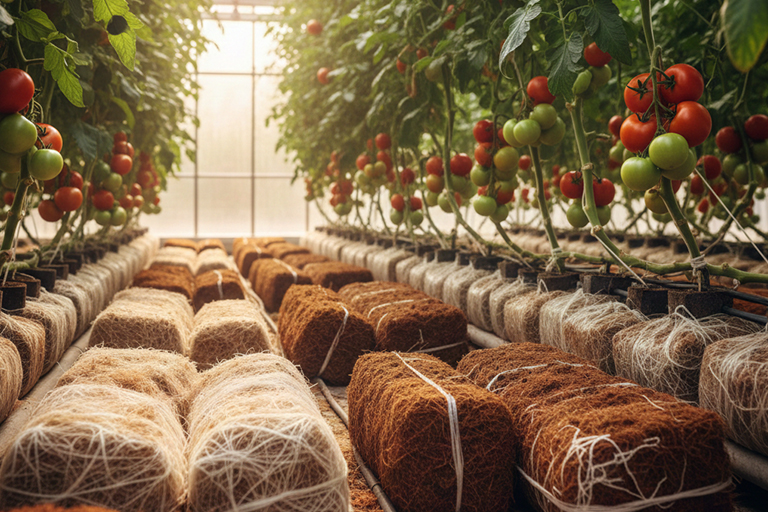
Coir slab comparison for tomatoes often starts with numbers—EC levels, dimensions, water-holding capacity. But growers who’ve worked through multiple seasons know something else matters just as much: how slabs behave once roots take over.
Two slabs can look identical on paper and perform very differently under a full tomato canopy. That’s why comparison only makes sense when it connects lab specs with real greenhouse outcomes.
Let’s walk through what truly separates one coir slab from another, and why those differences show up in yield, fruit consistency, and day-to-day management.
All coir slabs start the same—but don’t stay that way
Most coir slabs begin life as compressed coco pith and fiber blends, hydrated and buffered before planting. Early performance usually looks similar across brands. Water uptake is even. EC seems fine. Roots establish quickly.
Then week six arrives.
By that point, differences in fiber length, compaction, and drainage behavior become impossible to ignore. Some slabs stay responsive. Others turn sluggish, holding water too long or drying unevenly across the slab.
That’s where a meaningful comparison begins.
How coir slab comparison for tomatoes reveals root-zone behavior over time
Tomato crops don’t forgive structural weakness. Long cycles demand slabs that resist collapse while still releasing excess solution.
Higher-quality slabs maintain pore space even after months of root pressure. Oxygen continues moving. Roots stay white and active deeper into the season.
Lower-quality slabs often compact unevenly. The top dries fast. The bottom stays wet. Roots cluster where conditions feel safest, limiting exploration and nutrient uptake.
Those differences rarely show up in early-stage trials—but they dominate mid- to late-season performance.
Fiber composition quietly controls drainage
Not all coco fiber is equal. Short fibers hold water aggressively. Longer fibers create channels that improve drainage and aeration.
In tomato production, slabs with a balanced mix tend to perform best. Too fine, and drainage suffers. Too coarse, and moisture retention becomes inconsistent.
This balance explains why slab origin and processing matter. For context on how coco fibers are sourced and prepared, this explanation of Coir provides useful background without drifting into theory.
EC behavior separates slabs faster than anything else
Two slabs may start with the same EC reading. After a few weeks, runoff tells a different story.
Slabs that were thoroughly washed and buffered release salts steadily through normal drainage. Others spike EC under stress—warm days, high transpiration, heavier feeding.
That spike affects:
- Calcium movement
- Fruit sizing
- Stress tolerance
Growers often notice blossom-end-related issues earlier in slabs that struggle to manage EC, even when fertigation programs stay unchanged.
This is where suppliers like Coco Labs place emphasis on consistent washing and buffering, because correcting EC after planting is far harder than preventing it.
Slab height and width influence irrigation strategy
Physical dimensions aren’t just logistical details. They influence how water spreads and drains.
Wider slabs distribute roots horizontally, improving stability. Taller slabs hold more solution but require careful irrigation timing to avoid saturation.
In coir slab comparison for tomatoes, growers often find that slightly taller slabs work better in cooler climates, while flatter profiles respond faster in warm, high-transpiration environments.
There’s no universal “best.” There’s only what fits the climate and irrigation rhythm.
Reuse potential varies more than advertised
Many slabs are marketed as reusable. Fewer actually perform well in a second cycle.
High-quality slabs maintain structure after root removal and flushing. Drainage returns quickly. EC resets predictably.
Lower-grade slabs compact permanently. Flushing becomes uneven. Water channels form where roots once dominated.
That difference determines whether reuse saves money—or creates new problems.
If you’re reviewing handling practices, this guide on Grow Bags also applies to slabs, especially when it comes to flushing, drainage, and EC monitoring.
Yield consistency beats peak yield claims
Some slabs push aggressive early growth. That looks impressive at first. But tomatoes reward consistency more than speed.
Slabs that support steady root activity produce:
- More uniform trusses
- Predictable harvest intervals
- Lower rejection rates
In commercial systems, that reliability matters more than short-term gains.
Climate amplifies slab differences
Under mild conditions, most slabs behave acceptably. Under stress, differences widen.
High light, heat, or humidity swings expose weaknesses fast. Slabs with poor drainage struggle. Slabs with unstable EC fall behind.
That’s why growers in regions like the Netherlands and Germany often run side-by-side slab trials before committing at scale. Controlled environments reveal subtle differences clearly.
A practical way to compare slabs on-site
Experienced growers don’t rely only on spec sheets. They observe:
- How quickly slabs respond after irrigation
- Runoff EC trends over time
- Root distribution when slabs are opened post-harvest
Those observations reveal more than marketing claims ever could.
The quiet role of uniformity
Within a single greenhouse block, uniform slab performance matters as much as slab quality itself.
Inconsistent slabs create uneven growth zones. Irrigation adjustments that help one row hurt another. Labor increases as teams chase symptoms instead of managing systems.
That’s why consistency across batches often outweighs minor differences in specifications.
A grounded takeaway
A coir slab comparison for tomatoes isn’t about finding perfection. It’s about reducing surprises.
The best slabs don’t demand attention. They stay predictable while everything else—weather, labor, markets—keeps shifting.
And in commercial greenhouse production, predictability is worth more than promises.
FAQs
What should growers look for in a coir slab comparison for tomatoes?
Drainage behavior, EC stability, and structural integrity over time.
Do all coir slabs perform the same early in the crop?
Often yes. Differences become clear later in the season.
Does slab height affect tomato yield?
Indirectly. It influences moisture retention and irrigation strategy.
Are coir slabs suitable for reuse?
Some are. Structural quality and EC management determine success.
Why does EC vary between coir slabs?
Differences in washing, buffering, and fiber composition.