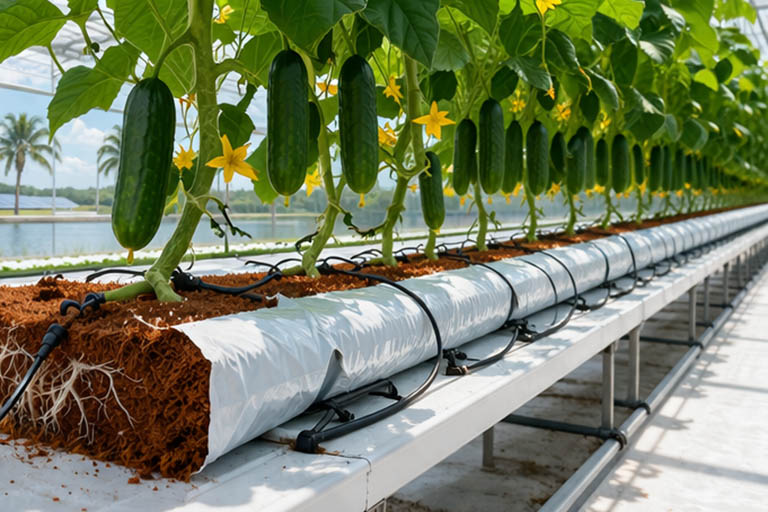
8 Growing Realities Behind Florida Hydroponic Cucumber Substrate Choices
A Florida hydroponic cucumber substrate has a tough job. Cucumbers grow fast, drink hard, and react quickly when the root zone loses balance. Add Florida heat, humidity, and the kind of environmental pressure that can turn a small management slip into a bigger crop issue, and the substrate suddenly becomes far more than a container under the plant. It becomes part of the steering system.
That is why cucumber growers tend to feel media performance very quickly. A tomato crop might let you negotiate with it for a bit. A cucumber crop is less patient. When the root zone holds too much moisture, roots can lose vigor. When it dries in a rough or uneven pattern, plant response can become jumpy. When the media differs from bag to bag, the whole house becomes harder to manage because cucumber growth does not hide inconsistency for long.
So yes, climate control, fertigation, cultivar choice, and labor discipline all matter. Of course they do. But the substrate is part of how those other decisions actually land in the crop. If it supports strong aeration, predictable drain back, and clean hydration behavior, the grower gets a crop that feels more readable. If not, even a decent plan can start wobbling.
For buyers looking at coir based systems, it helps to understand coir as a horticultural medium rather than just a coconut byproduct. It also helps to review broader crop and coconut research through the Coconut Research Institute Sri Lanka. Operations training newer teams can also lean on a practical grow bag guide, while Coco Labs serves as a straightforward reference point for product discussion.
Why Florida Hydroponic Cucumber Substrate Must Handle Heat Without Turning Heavy
Florida growers live with a reality that shapes everything: warmth arrives early, humidity lingers, and crop pressure can build fast. That does not mean every root zone must run dry. Far from it. Cucumbers still need reliable moisture. But the media must hold that moisture without becoming dense, stale, or sluggish. In a humid climate, a substrate that stays heavy for too long can turn the whole irrigation strategy into guesswork.
This is where air filled space becomes one of the most practical qualities in the media. Not because it sounds technical, but because cucumber roots appreciate a root zone that feels alive rather than clogged. When roots have moisture and oxygen in the right relationship, the crop tends to move with more confidence. Leaves look more decisive. Growth feels less erratic. Fruit set and quality become easier to guide.
And let us be honest, cucumber crops have a certain attitude. They reward good management quickly, and they punish sloppy details quickly too.
Cucumbers tell the truth about substrate faster than most crops
There is something useful about cucumber crops: they do not let managers stay confused for long. If the media is too wet, the crop often shows it. If the irrigation plan is off, the crop shows it. If one section of the greenhouse is behaving differently because the substrate was not uniform, the crop shows that too.
That honesty is valuable. It means growers can learn fast. But it also means the input materials need to be reliable from the start. A media that rehydrates unevenly or drains inconsistently can create unnecessary stress right when the crop is meant to establish cleanly.
This is why good cucumber growers care deeply about repeatability. They do not want to babysit the substrate. They want the substrate to support the crop while they steer the greenhouse around weather, pruning, labor timing, and harvest pressure.
Drain back is not a side topic in warm regions
When people talk about hydroponic media, they often focus on water holding first. Fair enough. But in warm, humid production environments, drain back deserves equal attention. A substrate that accepts irrigation but lets the excess move away in a steady manner can help prevent the root zone from staying too saturated. That matters even more when the crop is drinking heavily and environmental pressure shifts across the day.
Coir based cucumber systems are often chosen because they can balance retention and drainage when processed correctly. Again, that final phrase matters. When processed correctly. Washing, buffering, particle balance, and bag structure all shape how the root zone behaves after irrigation pulses begin.
Poorly prepared material can make the crop harder to read. Well prepared material supports a rhythm that the grower can work with instead of fight against.
A mid article visual snapshot for practical thinking
Think of cucumber substrate management in four plain stages.
At planting: you want even hydration and a clean, welcoming start.
During rapid vegetative growth: you want moisture available, but not suffocating.
At peak fruiting: you want strong daily steering without chaos in the root zone.
Late in the cycle: you want predictability, because fatigue in the crop and fatigue in the team often arrive together.
If the substrate behaves consistently through all four stages, a lot of operational tension disappears.
Washed and buffered media gives the feed program a fair chance
Fertigation only tells the truth when the media is not distorting the message too much. That is one of the quiet strengths of well prepared coir. When it has been washed properly and buffered for horticultural use, the grower can interpret feed and drain readings with more confidence. Early root development tends to be steadier, and the crop is less likely to start with avoidable background issues.
This matters for cucumbers because the crop moves quickly. If the root zone starts off unstable, the cost of correction arrives sooner. A small issue in establishment can become a larger issue by the time the plant is pushing hard.
That is why experienced buyers ask for detail rather than trusting nice packaging. What was done to the media before it reached the greenhouse? How does it behave after hydration? Does the supplier understand cucumber pacing, or are they speaking in generic terms that could apply to anything?
Uniformity is a labor saving tool, even if nobody calls it that
One of the most useful things about consistent substrate is how much labor confusion it prevents. If every bag in the house behaves roughly the same way, irrigation decisions become simpler to apply. Crop observations carry more meaning. Workers do not have to keep remembering which section runs wetter or which row dries differently for no obvious reason.
That sort of consistency feels quiet, but it is powerful. It lowers mental clutter. It also helps new staff learn faster because the system behaves in a teachable way.
A grower once said, “I used this type of bag for my cucumber house, and the nicest part was how predictable the morning readings became after the first two weeks.” Another said, “Our customers were really happy with the cleaner root start, and the team felt the crop came into rhythm without so much guessing.” Those are the sorts of comments that stick because they sound like work, not performance.
Florida conditions reward media that can recover cleanly
Heat and humidity do not just increase demand. They also amplify mistakes. A substrate that becomes too compacted or too slow to release excess moisture can turn a normal hot spell into a stressful week. On the other hand, a media with a good physical structure can help the crop recover more smoothly after heavy uptake periods or sudden environmental shifts.
That does not mean the substrate alone solves climate pressure. It does not. But it can either support recovery or slow it down. In practice, that distinction matters a lot. Growers who work under warm conditions usually care deeply about how the media behaves after a strong irrigation day, after a weather swing, or after a period of intense crop demand.
They are not asking for magic. They are asking for a substrate that keeps the root zone from becoming the weak link.
Packaging and handling still shape real outcomes
There is also the basic operational layer. Compressed grow bags and slabs are useful because they store and ship efficiently, but the product still has to expand well, hold shape, and fit the greenhouse workflow. If the bag tears too easily, hydrates poorly, or settles unevenly, the crop starts with friction that nobody wanted.
Professional growers notice these things quickly. They judge the supplier not only by the crop response later, but by the practical handling on day one. Did the bags set up cleanly? Did they accept water evenly? Did the expected volume match reality? Could the staff move through installation without extra headaches?
These details matter because commercial greenhouses are built from repeated small actions. A good input supports those actions. A bad one slows them down.
The smart question is not “Will this work?” but “How well will this behave under pressure?”
Almost any reasonable horticultural medium can support plant growth under calm conditions. The real question is what happens when pressure shows up. What happens during high demand weather? What happens when the crop is pushing hard? What happens when the irrigation manager needs the substrate to respond in a predictable way and not in a dramatic one?
That is where a Florida hydroponic cucumber substrate earns or loses trust. Under pressure, the media reveals its character. Good media feels stable, teachable, and supportive. Weak media feels noisy.
And noisy systems are exhausting.
Why growers should keep the conversation grounded
Agricultural marketing sometimes drifts into language that sounds pretty but says very little. Professional growers usually see through it. They want grounded communication. They want to know whether the media is washed, buffered, consistent, and crop appropriate. They want to know whether other growers have used it successfully under real management conditions. They want the supplier to speak plainly.
That plainness is not boring. It is respectful.
A useful article on substrate should respect the reader in the same way. It should not overpraise the seller or pretend one media choice replaces crop skill. What it should say, clearly, is that the root zone matters, especially for cucumbers in warm climates, and that a better medium can make a hard job more manageable.
That is still a strong message. Maybe stronger because it sounds true.
The takeaway growers can actually use
When the crop is cucumber, the system is hydroponic, and the setting is warm and humid, the substrate has to do real work. It must hydrate evenly, allow good air space, support steady drain back, and stay consistent enough that the grower can trust the signals coming from the crop. Those are not luxury features. They are operating essentials.
So if a grower is comparing media, the useful questions are simple. Is it processed well? Is it washed and buffered? Is the structure right for the crop? Will it behave the same way every time? Can the supplier talk clearly about performance without resorting to empty drama?
If those answers are strong, the crop usually gets a better start. And for Florida hydroponic cucumber substrate, a better start often means a calmer season.
FAQ
1. Why do cucumbers need a more carefully managed substrate than some other crops?
Cucumbers grow quickly and respond fast to root zone changes. If the media stays too wet, too dry, or behaves unevenly, the crop often shows it right away.
2. Is coir a good choice for hydroponic cucumbers in warm climates?
Yes, especially when it is processed properly. Good coir can hold moisture while still supporting air space and dependable drainage, which helps under warm production conditions.
3. Why is buffering important in cucumber media?
Buffering helps the media behave more predictably once fertigation starts. That gives the feed program a fairer chance to perform as intended.
4. What should growers ask a substrate supplier before buying?
Ask about washing, buffering, particle composition, rehydration behavior, drainage pattern, consistency between batches, and crop suitability.
5. Can a better substrate reduce management stress?
Very often, yes. A more consistent root zone makes irrigation decisions clearer, helps teams trust readings, and reduces the need for constant correction.