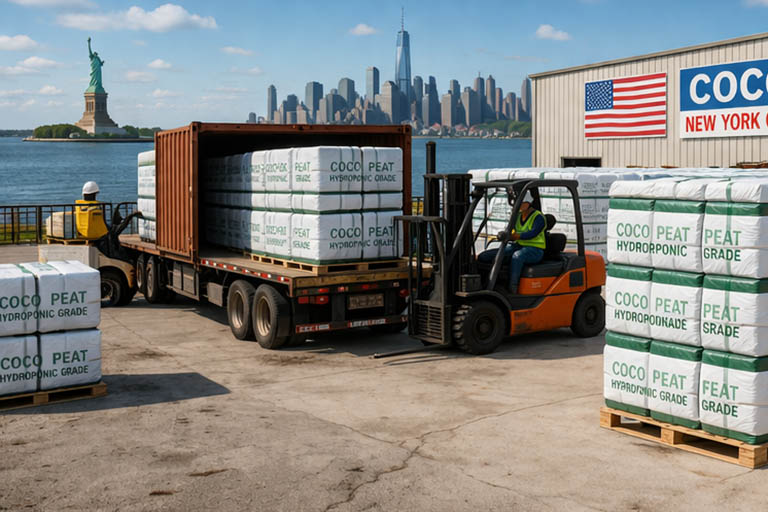
6 Buying Signals That Matter When Choosing a New York Commercial Coco Peat Supplier
A New York commercial coco peat supplier is not just selling bags, blocks, or compressed media. They are stepping into the daily logic of a greenhouse or farm operation. That is a bigger role than some sellers admit. Once the substrate is laid out, hydrated, planted, irrigated, and pushed through a commercial crop cycle, every weak point in sourcing shows up somewhere. Sometimes it shows up in drain readings. Sometimes in uneven rooting. Sometimes in labor stress. Sometimes in the quiet sentence a grower says at the end of a rough week: “This batch is not behaving like the last one.”
That is why commercial buyers do not really buy coco peat on appearance alone. They buy confidence. They buy repeatability. They buy the chance to run a crop without losing time to preventable media issues. And yes, price matters. Freight matters. Lead time matters. But when the crop is in motion, the cheapest product on paper can become the most expensive one in practice if it forces the greenhouse to spend the whole season making corrections.
This is one reason professional teams often keep supplier review tied closely to crop performance notes. They do not separate purchasing from production because the greenhouse does not separate them either. What looks like a logistics decision in the office often becomes a root zone decision on the floor.
For anyone comparing suppliers, it helps to read a basic overview of coir to understand the material itself, then look at crop and coconut knowledge from the Coconut Research Institute Sri Lanka. Teams that are new to bag based systems may also find this grow bag guide useful, while Coco Labs offers a product reference point without forcing the article into a company sales pitch.
Why New York Commercial Coco Peat Supplier Decisions Affect the Whole House
A commercial greenhouse is built on repeatable routines. That sounds obvious, but it is the heart of the matter. Watering routines, feed routines, labor routines, scouting routines, harvest routines. Good operations get strong because they reduce noise. When a supplier sends media that varies too much between batches, they add noise to the system.
And noise is expensive.
One row hydrates evenly, another stays denser. One section drains as expected, another lags behind. The irrigation manager starts splitting decisions. The crop scout sees plant response that feels inconsistent. Staff begin working around the substrate rather than through it. That is not a media issue anymore. It is a management burden.
This is why serious buyers ask a very plain question: “Will this product behave the same way every time we buy it?” A supplier who cannot answer that with detail is asking the buyer to take on too much risk.
Price is visible. Variability is sneaky.
Most people compare offers by price per unit, shipping terms, and lead time. Fair enough. Those are easy to measure. What is harder to see is the cost of inconsistency. That cost appears in slower crop establishment, more hours spent checking moisture behavior, more confusion around feed response, and more staff time spent solving things that should have stayed simple.
A product that saves a little money at purchase can quietly cost more in handling and crop steering. Professional growers know this, even if it is hard to capture neatly in a spreadsheet. They feel it in the rhythm of the house. When the media is stable, the crop feels readable. When the media is erratic, the whole greenhouse gets tense.
Honestly, that tension matters. A calm crop lets people make better decisions.
Washing, buffering, and material blend separate serious suppliers from casual traders
Coco peat is not automatically suitable for intensive horticulture just because it comes from a coconut producing country. Processing quality matters. Was the material washed properly? Was it buffered for hydroponic performance? Is the particle mix designed for the crop and irrigation style? Does the supplier know how to explain the difference between pith heavy media and blends that include more fiber?
Commercial buyers should expect straight answers here. Not broad claims. Not vague promises. Straight answers.
A good supplier also understands that different crops and climates need different responses. Tomatoes, cucumbers, peppers, berries, and ornamentals do not all ask the same things from the root zone. Even within the same crop, a winter program and a summer program may ask for slightly different behavior from the media.
That is why it helps when a supplier talks less like a trader and more like someone who has listened to growers for years.
A simple supplier check, written like people actually use it
Here is a practical way to think about supplier evaluation.
Product quality: Does the media hydrate evenly, drain well, and stay consistent from batch to batch?
Processing confidence: Can the supplier explain washing and buffering without dodging the question?
Crop fit: Do they understand whether the product suits tomatoes, cucumbers, or mixed commercial production?
Shipping discipline: Do orders arrive in workable condition and within usable timelines?
Support: If a batch behaves differently, does the supplier respond clearly and quickly?
That little framework is not flashy. It works because it mirrors how commercial teams actually think.
Good supplier relationships reduce friction in ways that are easy to overlook
Some of the best sourcing decisions never become dramatic stories. They simply make life easier. The media arrives on time. The bags expand properly. The crop roots in evenly. The irrigation team gets the kind of response they expected. The greenhouse keeps moving. Nobody has to stop and rework the whole plan.
That kind of reliability has emotional value as well as operational value. People trust a system that behaves. Managers can delegate with more confidence. Teams do not have to second guess whether a weird reading comes from weather, from fertigation, or from substrate inconsistency.
One grower summed it up in a refreshingly plain way: “I used this for my main tomato range, and what I liked most was not having to keep adjusting for odd differences between blocks.” That sounds small until you have managed a large house under time pressure. Then it sounds like relief.
Commercial buyers should ask about the boring details
There is real wisdom in boring questions. What is the expansion ratio? How stable is moisture distribution after initial hydration? What are the standard dimensions? What crops is the blend commonly used for? What is the expected drainage behavior? Can the supplier provide basic specification sheets without making the buyer chase them for weeks?
These questions do not make exciting marketing content, but they do make good purchasing decisions.
A dependable supplier knows that serious buyers want facts. They do not treat technical questions as a nuisance. They welcome them because technical questions usually mean the buyer intends to use the product well and buy again if the experience is solid.
That is also where trust grows. Not in glossy slogans. In clean answers.
The New York angle is practical, not decorative
There is a reason location matters in this conversation. Buyers serving New York operations often work with crop schedules that demand precision, especially where protected cultivation has to stay efficient across seasonal shifts. Supply delays, product inconsistency, or weak technical guidance can create ripple effects that feel larger than they would in looser systems.
That is why a New York commercial coco peat supplier should be judged on how well they fit real production pressure. Can they support consistent crop management? Can they handle repeat business without changing the product personality every few shipments? Can they communicate clearly enough that procurement and production stay connected?
These are not abstract questions. They show up in weekly outcomes.
A supplier should sound like someone who has stood near a crop
The best supplier communication has a certain tone. It is calm. Specific. Practical. It talks about root development, drainage, feed response, bag opening, and crop establishment. It does not lean too heavily on polished adjectives. It sounds like someone who has heard actual greenhouse complaints and learned from them.
That tone matters because agriculture has a sharp ear for nonsense. Buyers may smile politely through fancy presentations, but when they make the purchase, they remember who answered clearly.
One customer comment I have heard in this space goes something like this: “Our staff were really happy with the way the bags settled after hydration, and the crop came into rhythm faster than expected.” That kind of line feels believable because it is grounded in work, not theater.
Long term value is built on repeat orders, not one impressive shipment
Anyone can look good on the first sample. The real test is whether the second order, the fourth order, and the eighth order feel just as dependable. Commercial growing relies on repeatability. If the supplier changes product character too often, the grower ends up relearning the root zone when they should be refining it.
That makes repeat order confidence one of the strongest buying signals. If a greenhouse team says, “We know what we are going to get,” that is a major compliment. It means the supplier has become part of a stable production system rather than a source of guesswork.
And that is really the goal. Not glamour. Not noise. Just a cleaner relationship between input and crop response.
Why thoughtful sourcing still wins
There is always pressure to move quickly. Markets shift. Freight shifts. Crop plans shift. Buyers cannot spend forever evaluating every media option. But thoughtful sourcing still wins because substrate is too central to treat casually. A better supplier choice can support crop quality, reduce labor friction, improve irrigation confidence, and keep management attention on higher value decisions.
So yes, price matters. Timelines matter. Availability matters. But if the conversation stops there, the buyer is leaving important things on the table. A stable, well processed media from a supplier who communicates clearly is often the safer commercial call.
That is why New York commercial coco peat supplier selection should sit close to crop strategy, not far away from it.
FAQ
1. What should a commercial buyer ask a coco peat supplier first?
Start with washing, buffering, particle composition, and batch consistency. Those answers tell you whether the supplier understands horticultural performance or is simply moving product.
2. Why is consistency more important than the cheapest quote?
Because inconsistent media creates crop steering problems, labor inefficiency, and management stress that can easily outweigh a small purchase price difference.
3. Is coco peat suitable for both tomatoes and cucumbers?
Yes, but the product blend and handling approach should suit the crop and irrigation style. A supplier should be able to explain that clearly.
4. How can I tell whether a supplier has real technical knowledge?
Listen to the language they use. Suppliers with real knowledge talk clearly about drainage, rehydration, root behavior, and processing steps. They do not hide behind generic sales phrases.
5. Does supplier location matter as much as product quality?
Product quality comes first, but location, freight planning, and communication discipline still matter a great deal in commercial production where timing and consistency are closely tied.