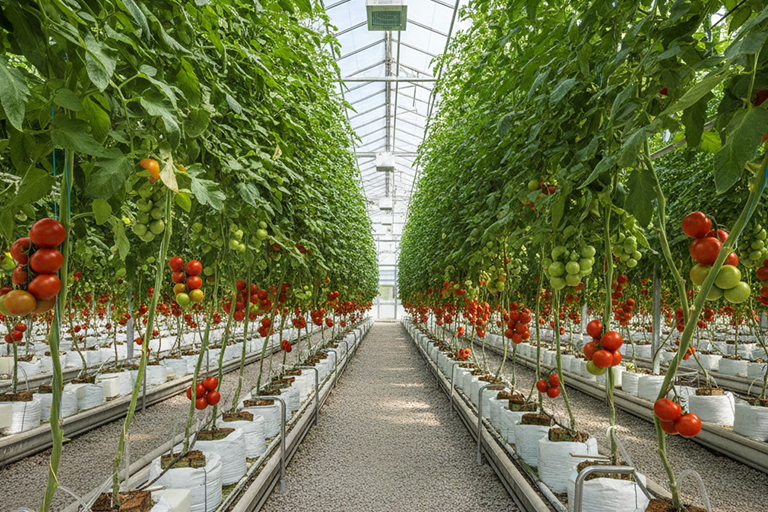
Commercial greenhouse substrates rarely get the same attention as climate systems or fertigation programs. Yet they quietly shape how crops behave every single day. When substrates perform well, nobody notices. When they don’t, problems appear that feel random, stubborn, and expensive.
Tomatoes stall. Capsicum drops flowers. Cucumbers lose uniformity. And the grower starts adjusting everything—except the substrate.
Let’s talk plainly about why substrate choice matters, what separates reliable materials from problematic ones, and how experienced growers think about this decision across global greenhouse systems.
Substrates don’t feed plants—roots do
It’s easy to think of substrates as passive holders for roots. In reality, they influence:
- Oxygen availability
- Water movement
- Nutrient access
- Root temperature stability
All of these affect how roots function, not just what nutrients are available.
Commercial greenhouse substrates succeed when they create conditions roots can tolerate day after day, not just when they look good at planting.
Why commercial greenhouse substrates shape daily decisions more than growers realize
Every irrigation adjustment, EC correction, or climate tweak interacts with the substrate first. If the substrate responds predictably, small corrections work. If it doesn’t, those same corrections cause new issues.
That’s why experienced growers often say, “The substrate decides how forgiving the system is.”
When substrates behave consistently, management becomes proactive. When they don’t, it becomes reactive.
Water behavior is the first test
Different substrates handle water very differently.
Some retain moisture aggressively, which sounds helpful until roots lose oxygen. Others drain quickly but dry unevenly, creating stress pockets.
Coco coir has gained traction because it balances these extremes. It absorbs water evenly and releases excess efficiently, creating a stable moisture profile across the root zone.
For context on how coco fibers behave structurally, this overview of Coir explains why coir-based materials resist compaction better than many alternatives.
Oxygen availability is often underestimated
Roots need oxygen continuously, not occasionally. Saturated substrates restrict oxygen movement even if nutrient levels look correct.
Commercial greenhouse substrates must maintain air-filled porosity throughout long crop cycles. That requirement becomes critical in tomato systems where roots remain active for many months.
Substrates that collapse under root pressure create anaerobic zones, leading to slow decline rather than sudden failure. By the time symptoms appear above ground, root damage is already established.
EC stability separates reliable substrates from risky ones
Electrical conductivity inside the root zone influences water uptake directly. High EC increases resistance, making it harder for plants to absorb moisture and nutrients.
Substrates that release salts gradually and respond well to drainage maintain EC stability. Others accumulate salts unevenly, creating hidden stress zones.
That’s why low-EC starting material matters—but so does how the substrate behaves after weeks of fertigation.
Suppliers such as Coco Labs focus on washing and buffering consistency because EC problems are far easier to prevent than correct mid-season.
Crop type influences substrate demands
Tomatoes, capsicum, and cucumbers share similarities, but their root behaviors differ.
- Tomatoes demand long-term structural stability
- Capsicum responds strongly to moisture consistency
- Cucumbers prefer fast drainage and high oxygen
Commercial greenhouse substrates must perform across these demands without forcing constant compromise.
Coco-based systems adapt well because irrigation strategies can fine-tune moisture levels without fighting the material itself.
Reuse changes the substrate conversation
Reuse isn’t just a cost decision. It’s a performance decision.
Substrates suitable for reuse maintain:
- Structural integrity after root removal
- Predictable drainage after flushing
- Stable EC response in subsequent cycles
Poor-quality substrates compact permanently, making reuse risky rather than efficient.
Growers who plan reuse from the beginning choose materials that reset cleanly between crops. Those who don’t often abandon reuse after one frustrating attempt.
Climate amplifies substrate behavior
Under mild conditions, many substrates seem acceptable. Under stress, differences become obvious.
High light increases transpiration. Warm root zones accelerate nutrient demand. Low humidity exaggerates water stress.
Commercial greenhouse substrates must perform under pressure, not just during ideal weeks. That’s why trials conducted in real production conditions reveal more than lab data alone.
Labor efficiency is tied to substrate predictability
Labor constraints are tightening globally. Substrates that forgive small mistakes reduce workload.
When substrates respond consistently:
- Irrigation schedules stabilize
- Fewer corrective flushes are needed
- Staff spend less time chasing symptoms
That operational simplicity matters as much as yield numbers.
If you’re aligning teams or revisiting system basics, this guide on Grow Bags helps connect substrate behavior with daily greenhouse routines.
Marketing claims vs. operational reality
Many substrates promise performance. Fewer deliver it consistently across seasons.
Experienced growers evaluate materials based on:
- How they behave late in the crop
- How quickly they reset after flushing
- How uniform they perform across batches
Consistency often matters more than peak performance.
Sustainability follows function, not the other way around
Environmental benefits matter, but they only stick when substrates work operationally.
Coco coir’s renewable origin is valuable, but growers adopt it because it performs reliably first. Sustainability becomes a secondary gain, not the primary motivator.
That practical mindset explains why coco-based commercial greenhouse substrates continue gaining adoption worldwide.
A grounded takeaway
Commercial greenhouse substrates don’t need to be perfect. They need to be predictable.
When substrates behave consistently, growers can focus on crop strategy instead of damage control. That shift changes everything—from labor planning to yield forecasting.
And that’s why substrate choice quietly shapes greenhouse success more than most people admit.
FAQs
What are commercial greenhouse substrates?
Materials used to support roots, manage water, and regulate nutrient access in greenhouse crops.
Why is substrate choice important in greenhouses?
It affects root health, nutrient uptake, and crop consistency.
Are coco coir substrates suitable for all greenhouse crops?
They work well for tomatoes, capsicum, and cucumbers with proper management.
Can commercial greenhouse substrates be reused?
Some can. Structural quality and EC behavior determine reuse success.
How do growers evaluate substrate performance?
By observing drainage, EC stability, and root health over time.