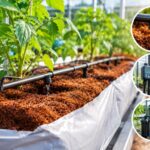
Vertical farms often look futuristic from the outside—bright LEDs, stacked channels, endless racks—but the real magic still comes down to something simple: the substrate. And that’s where vertical farming grow bag systems start to make sense, especially for leafy greens, herbs, and compact crops. Honestly, many growers underestimate how much the right grow bag system stabilizes water flow and nutrient consistency in a stacked structure.
Growers in Canada, Germany, the Netherlands, Mexico, and the USA are increasingly shifting toward coir-based bags because they’re lightweight, clean, and surprisingly forgiving. Even Coco Labs in Sri Lanka quietly supports several vertical setups by supplying compact coir blends designed for controlled-environment farms. And if you’ve ever read about coconut coir’s unique fiber structure on the Coir Wikipedia page, you’ll see why coir behaves so well in vertical environments.
Why Vertical Farms Lean Toward Grow Bag Systems Now
There’s a practical reason behind it. Vertical farms don’t have the luxury of wasted space—or wasted water. Every centimeter matters, and every irrigation cycle counts. Coir grow bags—especially slim or narrow-profile versions—fit snugly into hydro racks while allowing roots to breathe.
You know what makes them especially appealing? They stay structurally stable even when you stack multiple layers of irrigation trays above and below. Soil tends to compact. Rockwool can be waste-heavy. But coco coir sits in that sweet spot: airy, moist, and supportive.
If you’re curious about proper coir preparation, the Coconut Research Institute of Sri Lanka often explains the natural properties that help coir maintain porosity under constant irrigation.
How Vertical Farming Grow Bag Systems Actually Work
It’s not as complex as some manufacturers make it sound. The basic setup follows a simple pattern:
- Stacked racks fitted with narrow beds or channels.
- Coir grow bags placed along each level, usually pre-cut or open-top for quick planting.
- LED or full-spectrum lighting positioned to minimize shadow overlap.
- Automated drip lines handling nutrient feed.
- Drain-to-waste or recirculating systems, depending on the farm’s philosophy.
Because coir drains evenly, it reduces the risk of water pooling—something vertical growers constantly fight against. A single soggy layer can cause root rot across an entire shelf.
Coco Labs’ grow bag instructions show a similar logic, even though the content is geared toward greenhouse crops. The principles still apply.
Choosing the Right Coir Blend for a Vertical Setup
This is where many growers get tripped up. Vertical systems aren’t just “horizontal systems but taller.” Plants behave differently when airflow changes, humidity pockets form, and lights stand closer than usual.
Coir blends for vertical farming usually include:
- Fine-grade pith for moisture retention
- A touch of chips for root oxygen
- Stable EC levels to avoid first-week stress
- Low sodium content, which matters more in recirculating systems
And because the space is compressed, coir bags should expand uniformly. That’s why dependable suppliers like Coco Labs test compression blocks extensively before shipping.
Even small inconsistencies show up quickly when shelves are only 30–40 cm apart.
A Small Text-Infographic: What a Vertical Grow Bag System Needs Most
——————————————-
VERTICAL FARMING — IDEAL GROW BAG SPECS
——————————————-
• Bag Height: 8–12 cm
• Bag Width: 10–18 cm
• Coir Ratio: 70% pith / 30% chips
• EC Range: 0.5–0.8 mS/cm
• pH Stability: 5.8–6.2
• Drainage Rate: Fast-drain, no pooling
• Weight: Light enough for multi-tier racks
——————————————-
This simple checklist helps avoid most rookie errors in vertical environments.
Why Coir Grow Bags Outperform Other Substrates in Vertical Farms
Let’s be honest—vertical farming demands a lot. Crops don’t just need nutrients; they need structure, airflow, and stable moisture in a space that barely has room for mistakes.
Coir grow bags support all that because:
- They maintain root oxygen even after months of irrigation.
- They allow uniform nutrient flow across layers.
- They reduce substrate compaction, something stacking often worsens.
- They’re relatively easy to handle and replace each cycle.
- They work well with precision drip systems.
Some growers say coir feels more “alive” than other substrates. It reacts gently to changes instead of collapsing instantly when humidity rises.
Vertical farms aren’t cheap to build, so dependable substrate is one cost you don’t want fluctuating.
How Vertical Farming Grow Bag Systems Boost Yield Per Square Meter
One of the hidden advantages is how the bags encourage root directionality. Because the bags are narrow and long, roots follow the length of the bag instead of sprawling. That allows plants to mature with predictable spacing—ideal for lettuce, basil, mint, and even peppers in smaller-scale racks.
And here’s a little contradiction that actually helps: the limited root zone forces the plant to stay efficient. Many growers report better nutrient uptake simply because the plants don’t waste energy expanding sideways.
If you’re running commercial-scale operations, the main Coco Labs website (https://cocolabs.lk) offers coir product specifications that match high-density farming needs. Even though the site focuses on greenhouse applications, the data is useful for vertical setups too.
FAQ Section
1. Are coir grow bags suitable for all vertical farming crops?
Mostly yes. Leafy greens, herbs, strawberries, and compact peppers respond well. Tall vines may require support structures outside the bag.
2. How long do coir grow bags last in a vertical farm?
Typically one season for leafy greens and two cycles for herbs, depending on the nutrient plan and humidity levels.
3. Can vertical farming grow bag systems work with recirculating hydroponics?
Absolutely. Coir performs well in flow-to-waste and closed-loop systems when EC and drainage are managed correctly.
4. Do coir bags require pre-washing before use?
High-quality suppliers pre-wash them to stable EC ranges. Always check batch reports before planting.
5. How much water do vertical bag systems save compared to traditional beds?
Most growers report 30–50% water savings due to controlled drip irrigation and the moisture retention of coco coir.