Peat-Free Growing Media for Professional Growers: 7 Things to Settle Before the Deadline
There is a particular kind of quiet that settles over a nursery office when somebody finally says the thing out loud. The deadline is close, the trials are half finished, and the growing media that worked beautifully last season is about to become a compliance problem. If you are a commercial grower in England right now, peat-free growing media for professional growers has stopped being a conversation about sustainability and started being a conversation about whether your crop plan survives the next eighteen months.
So let us go through it properly. Not the policy summary, the practical version.
Where the rules actually stand
Retail went first. Bagged peat compost for amateur gardeners came off the shelves at the end of 2024, and most growers watched that happen from a safe distance.
The professional side is messier. Defra originally signalled 2030, then moved the intended date forward to the end of 2026, with a set of time-limited exemptions that let certain uses continue toward 2030. Plug plants and mushroom production sit inside those exemptions, which matters more than it sounds, because together they accounted for roughly 42 percent of all peat used by professional growers in 2021.
The Horticultural Trades Association has pushed back hard on the earlier date, arguing it arrived without a full impact assessment and that growers need the longer runway for trials. That argument is still live, which is exactly why you should check the current legislative position yourself rather than trusting a blog post, including this one. The HTA peat page tracks it, and the government response to the peat consultation sets out the underlying policy.
What you should not do is assume the date will slip again and plan accordingly. Plenty of businesses did that in 2023.
1. Work out which of your crops is actually the hard one
Most nurseries do not have a peat problem. They have two or three crops with a peat problem and a lot of crops that would switch tomorrow without anybody noticing.
Start by splitting your production list into three groups. Crops already running peat-free or close to it. Crops where a blend at 30 to 50 percent reduction works and the rest is habit. And the genuinely difficult ones, usually the slow, fine-rooted, long-cycle subjects where water management is tight and a mistake shows up months later.
That third group is where your trial budget goes. Spreading effort evenly across everything is how growers burn two seasons and end up no further forward.
2. Accept that you are buying a blend, not a replacement
This is the single biggest mental shift, and it trips up experienced growers constantly.
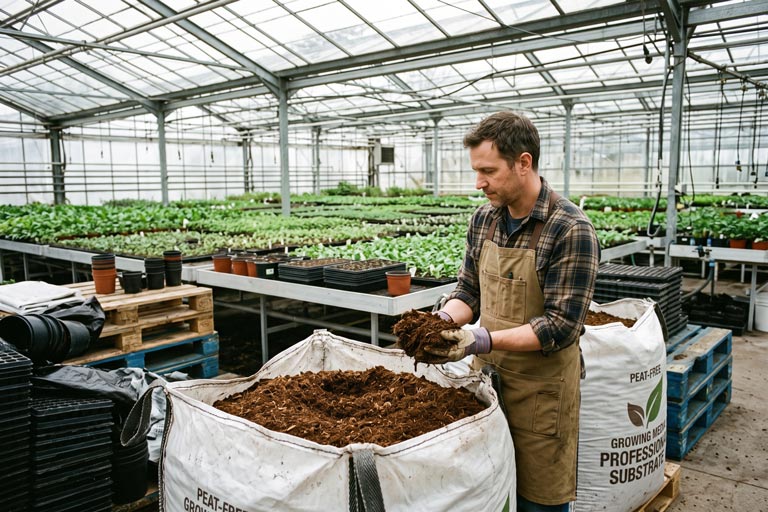
There is no material that behaves exactly like peat. What there is, instead, is a set of components with different strengths that get blended to approximate what you need. Coir brings water buffering, structure and a predictable particle grade. Wood fibre brings air and drains fast. Bark adds structure and some disease suppression. Composted green waste brings nutrition and variability in roughly equal measure.
Blends do the job. Single substitutes rarely do.
Which means the question stops being “what replaces peat” and becomes “what ratio, for which crop, with which irrigation strategy”. That is a harder question, but it is at least answerable.
3. Rebuild the irrigation plan, not just the recipe
Here is the thing growers underestimate most. Your watering regime is tuned to peat, and peat-free blends do not behave like it.
Most coir-led blends hold water well but release it more gradually, which forgives a missed cycle. Wood fibre heavy mixes drain quickly and want more frequent, smaller shots. Bark blends sit somewhere in between and can look dry at the surface while holding plenty below.
If you change the medium and keep the schedule, you will see one of two outcomes: a waterlogged root zone with falling air-filled porosity, or a crop running short by mid afternoon. Both get blamed on the substrate. Neither is the substrate’s fault.
Budget time for your irrigation manager, not just your purchasing manager.
4. Nutrition shifts, and calcium is usually the first casualty
Peat is relatively inert. Coir is not: it has cation exchange capacity, so it interacts with calcium, magnesium and potassium in the feed.
Unbuffered coir releases potassium into your nutrient solution across the first few weeks, displacing calcium and producing deficiency symptoms in a crop you fed plenty of calcium. Blossom end rot, tip burn, the general sense that something is wrong that takes a month to diagnose.
Properly buffered material arrives with calcium already occupying those exchange sites, which removes the problem at source. Composted green waste brings its own nutrition and its own batch-to-batch variation, so if your blend includes it, test rather than assume.
Ask your supplier for the feed adjustments that go with their blend. A supplier who cannot talk you through that conversation is selling you a commodity, not a growing medium.
5. Trial properly, which means small and measured
A trial that compares one bench of peat-free against a whole house of peat is not a trial. It is an anecdote waiting to be over-interpreted.
Run at least two seasons where you can. Keep the trial and control under the same climate and the same irrigation zone if possible, or accept you are comparing two variables at once. Record root zone EC and pH weekly rather than at the end. Photograph roots, not just tops.
And decide your success criteria before you start. Growers who define them afterwards tend to find whatever result they hoped for.
A tree nursery manager in Kent put the learning curve plainly: “I used this as like this for my first season, switching one line to a blend and running the same feed and the same irrigation as the peat crop next to it, and the plants told me within six weeks. Second season we rebuilt the schedule first and the difference was night and day. The medium was never the problem.”
6. Check supply before you commit a crop plan
This is where peat-free planning collides with reality.
Coir comes mostly from India and Sri Lanka, which means ocean freight and a lead time measured in weeks rather than days. Through 2026, vessel shortages and rolled bookings have made that lead time less predictable than anyone would like, with exporters reporting substantial additional cost per container. Wood fibre and bark are regional, but UK supply is finite and the whole sector is reaching for the same tonnage at the same time.
If your 2027 crop plan depends on a blend you have not secured, you do not have a crop plan. Order a season ahead, agree specifications in writing, and keep a buffer in the shed. Compressed coir blocks make that easy because they store dry and take up very little space.
7. Get the paperwork ready for your buyers
Retail customers are asking about growing media now, and the questions are getting more specific.
The Responsible Sourcing Scheme assesses the environmental impact of each raw material in a blend, and buyers increasingly want to see that assessment rather than a claim. You will also be asked about carbon footprint, water use in production and end-of-life route.
Have the answers in a document before somebody asks for them in an audit. It is a much better feeling than assembling them under pressure.
Peat-free growing media for professional growers: a starting point by crop
| Crop type | Blend direction | Watch for | Trial priority |
| Soft fruit, substrate grown | Coir led, chip heavy for air | Air-filled porosity, sodium | Low, coir is already standard |
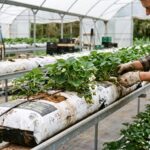
| Glasshouse vegetables | Coir led, 70:30 pith to chip | EC drift, calcium balance | Medium |
| Container ornamentals | Coir with bark and wood fibre | Structure over a long season | High |
| Young plants and plugs | Fine coir, buffered, low EC | Salt sensitivity in week one | High, exemption may apply |
| Trees and shrubs | Bark and wood fibre with coir | Stability over multiple years | Highest |
| Propagation, cuttings | Fine coir or coir blends | Uniform wetting, physical integrity | Medium |
Treat it as a conversation starter with your agronomist rather than a specification.
What growers report once they are through it
A container nursery in Worcestershire was candid about the commercial side: “Our customers are really happy with our peat-free lines now, and they said like this, the plants hold better on their shelves than the peat ones did. That was not what we expected and it certainly was not what we promised them.”
The pattern across businesses that got there without pain is consistent. They started early, they trialled narrow, they rebuilt irrigation before blaming the medium, and they treated their supplier as a technical partner rather than a price list.
The ones who struggled almost all share a different pattern. They waited for clarity on the dates, then tried to switch everything in one season.
Frequently asked questions
When exactly does the professional peat ban take effect?
Defra’s stated intention has been the end of 2026 for professional use, with time-limited exemptions extending certain uses toward 2030, including plug plants and mushrooms. Industry bodies have contested the earlier date and the position has moved before, so confirm the current legislative status through official sources before building it into a plan.
What is the best peat-free growing media for commercial growers?
There is no single best option, which is an unsatisfying answer but a true one. Most commercial blends are coir led for water buffering and structure, with wood fibre or bark added for air and drainage. The right ratio depends on crop, pot size, cycle length and your irrigation system.
Will peat-free media cost more?
Usually yes on the invoice, and sometimes no overall. Coir ships compressed, which reduces freight per litre, and coir-led blends in substrate crops often carry two or three seasons where peat carries one. Run the cost across the full crop cycle rather than per bag, including disposal.
Do I need to change my fertiliser programme?
Almost certainly. Coir has cation exchange capacity that peat largely lacks, so calcium, magnesium and potassium behave differently in the root zone. Most growers switching to a coir-led blend raise calcium and magnesium relative to their old recipe. Have an agronomist rework it rather than adapting the peat programme.
How long should a peat-free trial run?
Two full seasons where your crop cycle allows it, because the first season teaches you the irrigation and the second tells you whether the result holds. One season gives you a result you cannot yet trust.
Can I blend down rather than going fully peat-free?
Reduction blends have been a sensible transition route for several years, and most growers have already taken substantial percentages out. Whether a partial blend remains legal after the deadline depends on the final exemption framework, so plan toward full replacement and treat a blend as a stepping stone rather than a destination.