Reusing Strawberry Coir Bags for a Second Season: 6 Checks Before You Replant
There is a pile of used coir bags sitting at the end of a tunnel somewhere in Herefordshire right now, and somebody is standing in front of it doing mental arithmetic. New bags cost money. Disposal costs money. The bags look perfectly fine. So the question arrives on its own: can these carry another crop?
Usually yes. Reusing strawberry coir bags is standard practice across a good part of the UK industry, and it is one of the few cost savings available to a soft fruit business right now that does not involve cutting something that matters. But “usually yes” is doing a lot of work in that sentence, and the growers who get burned are almost always the ones who treated it as automatic.
Six checks, in the order they will save you money.
Why this came up again this year
Soft fruit margins have been squeezed from several directions at once. Labour costs, energy, inputs, and a drought summer that pushed irrigation costs up across the board. British Berry Growers has been making the case that years of investment in reservoirs and rainwater storage are what kept growers producing through one of the hottest and driest summers on record, while arguing that barriers to further water investment need removing. You can follow the sector’s position through British Berry Growers.
In that climate, substrate reuse stops being a nice idea. Suppliers have been actively encouraging it, pointing out that growers have three realistic routes with a used bag: replace it, keep it in situ and replant, or send it to a composting facility.
The middle option is the one worth getting right.
1. Look at the roots before you look at the bag
Open one. Not three bags from the tidy end of the row, one from the middle and one from the worst-looking patch you had last season.
What you want to see is a root mass that pulls apart reasonably and smells of nothing much. What should stop you is anything brown and soft, anything that smells sour, or a root plate so dense and matted that new roots will be fighting for space rather than growing into it.
Crown rot is the specific thing to worry about here, and the research is not reassuring if you are casual about it. NIAB’s work with Overland found that levels of Phytophthora cactorum tend to increase in directly reused and composted coir compared with virgin material, although that pattern did not show up in fully recycled coir processed properly. The NIAB coir recycling project is worth reading before you commit a block.
If you had crown rot pressure last season, the honest answer is replace rather than reuse. The saving is not worth carrying an infection into a fresh planting.
2. Check what happened to the air
This is the measurement that matters most and the one almost nobody takes.
Coir changes as it works. The same NIAB research found that recycled coir gains water-holding capacity and loses air-filled porosity compared with virgin material, with the size of that shift varying noticeably between manufacturers. Recycled material also showed slightly lower pH, higher electrical conductivity and higher nutrient content.
That matters for strawberries more than for almost any other crop, because soft fruit wants air in the root zone more than it wants water. A bag that has quietly gone from 28 percent air-filled porosity to 18 percent is not the same product you bought, even though it looks identical.
You can get a rough read by squeezing a handful and watching how fast water runs out, but if reuse is becoming a standing policy rather than a one-off, send samples for proper physical analysis. Knowing the number for your bags, your supplier and your second season is worth the lab fee.
3. Deal with the salts and nutrients you inherited
Spent bags are not empty. They carry a nutrient load from the previous crop, and research on reused strawberry substrates has consistently found higher nitrogen, phosphorus, potassium and magnesium than virgin material, with calcium slightly lower.
That is partly a gift and partly a trap. The gift is real fertiliser value, enough that growers reusing media can meaningfully reduce early-season feed. The trap is that you will not know how much unless you measure, and feeding a second-season bag on a first-season recipe is how electrical conductivity climbs past where you want it in week three.
Flush thoroughly before replanting, then test the leachate rather than guessing. Adjust the opening feed downward and build back up based on what the plants and the readings tell you.
4. Sterilise properly or do not bother pretending
Steam works, but only if the whole substrate mass reaches temperature and holds it. A quick pass with a hood over stacked bags heats the outside of the pile and leaves the middle untouched, which is worse than doing nothing because it feels like protection.
Chemical sterilisation needs genuine contact time with the whole mass, not a surface wetting. And a surface disinfectant label does not mean a product is validated for a porous growing medium, so do not improvise a recipe.
If you cannot treat the full mass reliably, you have two honest options. Reuse only bags from blocks with no disease history and accept the residual risk, or replace. Guidance from extension services consistently lands on the same point: reusing unsterilised media carries disease risk, and the convenience of assuming otherwise is not worth a crop.
5. Decide between replanting in situ, refilling troughs, or composting
Growers running reuse at scale generally have three routes and pick per block rather than per farm.
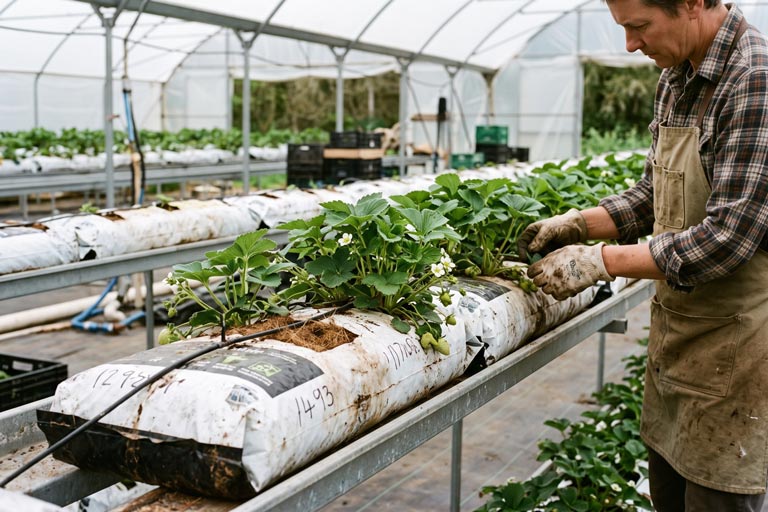
Keeping bags in situ and replanting is the cheapest and fastest, with no handling cost and no filling equipment. It also carries the most risk, because whatever was in that bag stays in that bag.
Emptying good coir into troughs or pots gives you a chance to screen out large roots, blend in some fresh material and get more even distribution. Many growers add 20 to 30 percent virgin coir at this point to bring air-filled porosity back up, which is a sensible middle path. The trade-off is labour, plus troughs and pots need washing and sterilising themselves when the coir is changed.
Composting on farm or sending to a composting facility is the right call for anything with a disease history or structural breakdown. Spent coir composts readily and goes back into field soil or on to landscapers, which turns a disposal cost into something closer to neutral.
6. Run a trial strip rather than converting the whole farm
Reuse is a production decision, not a property of the bag.
Leave a strip of virgin bags alongside your reused block under the same irrigation zone. Compare root development at four and eight weeks, not just yield at the end. Track electrical conductivity in both, because the reused block will run differently and you want to know how differently before it matters.
A soft fruit grower in Kent described the result plainly: “I used this as like this for my second season, replanting straight into last year’s bags without flushing or adjusting the feed, and the crop ran hot on EC for a month before I worked out why. Same bags, second time round, flushed and fed properly, and they performed within a whisker of the new ones.”
That is the shape of it. The material is rarely the problem. The process around the material usually is.
Reusing strawberry coir bags: a decision table for the pile
| Condition of the block | Sensible route |
| No disease history, bags intact, good drainage | Replant in situ after flushing and feed adjustment |
| No disease history, bags compressed or channelled | Empty into troughs, screen roots, blend 20 to 30 percent virgin |
| Crown rot or root rot last season | Replace. Compost or dispose of the old material |
| Air-filled porosity measurably below crop requirement | Blend with virgin coir or replace |
| Third season, structure breaking down, fines rising | Compost, use as soil improver or sell on |
| Unable to sterilise the full substrate mass | Reuse only clean blocks, or replace |
Pin it where the decision actually gets made, which is next to the bag pile and not in the office.
Frequently asked questions
How many seasons can strawberry coir bags be reused?
Two to three seasons is realistic for good quality bags that are sterilised properly between crops, and some growers push further with trough systems where fresh material is blended in. Watch air-filled porosity and rising fines rather than counting years, since the rate of change varies by manufacturer and by how hard the crop worked the substrate.
Does reused coir reduce strawberry yield?
Published work on substrate reuse in table-top strawberry production has found that spent growing media can be directly reused for another cultivation without negative impact on yield or fruit quality, provided it is handled properly. Problems in practice trace back to disease carryover, an unadjusted feed programme or air-filled porosity that has dropped below what the crop needs.
How do I sterilise coir grow bags between crops?
Steam is the recognised method, provided the entire substrate mass reaches the validated time and temperature for your protocol rather than just the surface. Remove debris and large roots first. Verify with probes in the middle of the mass instead of assuming, and do not substitute a surface disinfectant for a validated process.
Should I add fresh coir to reused bags?
Many growers blend 20 to 30 percent virgin material when emptying bags into troughs, which lifts air-filled porosity back toward where it started and refreshes the physical structure. It is a reasonable compromise between full replacement and straight reuse.
What do I do with coir I cannot reuse?
It composts. Spent coir goes back into field soil as an improver, on to landscapers, or into a composting facility, which avoids the tipping fees that come with materials that cannot break down. That end-of-life route is one of the clearer advantages coir holds over mineral substrates.
Do I need to change the feed for a second season bag?
Yes. Reused media carries elevated nitrogen, phosphorus, potassium and magnesium and slightly lower calcium compared with virgin. Flush, test the leachate, then open at a reduced feed rate and build up based on readings rather than running last season’s programme unchanged.