Peat-Free Substrate for Glasshouse Tomatoes: 8 Decisions That Make or Break the Switch
Walk into a British tomato house in February and the thing you notice first is the heat. The second thing, if you know where to look, is what the plants are sitting in. For most UK glasshouse growers that has been rockwool for a long time, with peat-based mixes doing the propagation work. Both of those arrangements are now under pressure, which is why peat-free substrate for glasshouse tomatoes has moved from a sustainability discussion to an operational one.
The switch is very doable. It is also easy to get wrong in ways that cost you a season, so here are the eight decisions worth getting right first.
Why this landed on your desk now
Two forces arrived at once, and neither is going away.
The regulatory one is familiar. Peat use in the professional sector faces restriction, with Defra having moved its intended date forward and industry bodies continuing to argue for a longer runway. Propagation media is where that bites hardest for tomato growers, since the production slab was rarely peat in the first place.
The economic one is nastier. UK protected horticulture has been absorbing a severe energy shock, with electricity network charges rising sharply and the sector sitting outside the Energy Intensive Industries exemption scheme that comparable manufacturers enjoy. The British Tomato Growers’ Association and the Cucumber & Pepper Growers’ Association have written to ministers warning that for businesses where energy can reach 30 percent of production costs, the combination is unsustainable. You can read the sector’s position through the British Tomato Growers’ Association.
When margins compress like that, every input gets examined. A substrate that can carry two or three crops instead of one stops being an environmental preference and starts being a cash-flow decision.
1. Decide whether you are replacing propagation media, production media, or both
These are separate projects and growers conflate them constantly.
Propagation is the tighter problem. Young roots have almost no buffer against salt, so the material needs lower starting electrical conductivity than anything you would accept in a production slab, and it needs to hold shape through a transplanting line.
Production is the bigger volume and the bigger financial decision, but it is technically more forgiving. A mature tomato plant will shrug off conditions that would stall a plug.
Start with propagation if you want a quick, low-risk win. Start with production if the driver is cost. Do not start with both.
2. Work out what you actually want from the root zone
Peat-free substrate for glasshouse tomatoes is really a question about air and water, and high-wire tomatoes want a specific balance.
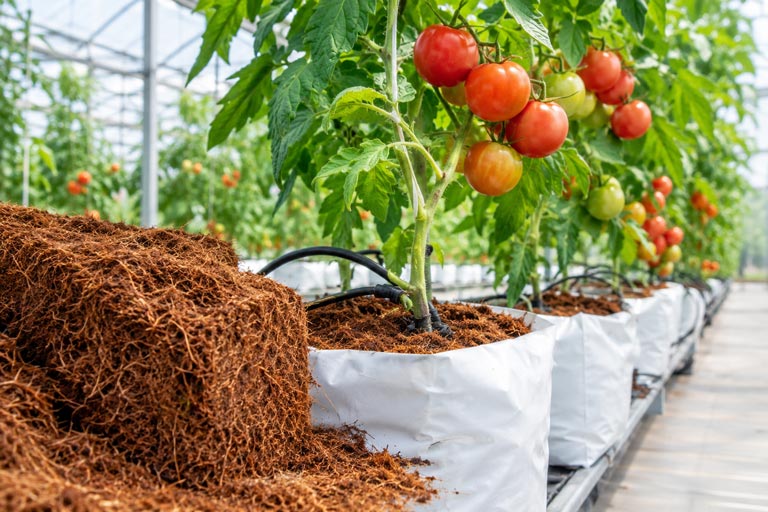
You are after enough water-holding capacity to carry the plant through a bright afternoon without constant irrigation, and enough air-filled porosity that roots keep breathing through a crop that runs the best part of a year. For coir-led blends in tomatoes, most growers land around 70 percent fine pith to 30 percent chip, giving air-filled porosity somewhere in the high teens and water holding around half the substrate volume.
Push the pith higher and you buy water buffering at the cost of air, which is where root problems start. Push the chip higher and you will be irrigating far more often than your system was designed for.
3. Rebuild the irrigation strategy before you blame the substrate
Coir does not behave like rockwool. That sentence costs growers more money than any other in the transition.
Rockwool is precise and unforgiving: it holds a lot of water, releases it predictably, and drops moisture fast when you miss cycles. Coir buffers. It holds water well and lets go of it gradually, which is genuinely useful on a site where power interruptions happen, and genuinely misleading if you keep your old schedule.
The practical changes are small shots delivered more often rather than large shots delivered rarely, a later first irrigation that waits for real transpiration, and an overnight dryback somewhere around 8 to 12 percent. A schedule built for rockwool applied to coir waterlogs the slab across a week without anybody noticing until the roots say so.
4. Get buffered material, and verify it
Raw coir carries potassium and sodium from the husk. That is chemistry, not a defect, and proper processing deals with it.
Washing removes sodium and chloride reasonably well. Buffering goes further: the material is soaked in a calcium nitrate solution so calcium occupies the cation exchange sites, and the displaced potassium and sodium are rinsed away. Skip that step and the substrate quietly rewrites your feed across the first few weeks of the crop, which shows up as calcium deficiency symptoms in a crop you fed plenty of calcium.
How do you verify it? Look at potassium on the lot report. Buffered material should come in well under about 150 ppm. If a sheet says buffered and shows potassium at 400 ppm, something does not add up and you should say so before the container ships, not after the crop tells you.
5. Plan the reuse strategy up front, not in year two
This is where the economics turn in coir’s favour, and it is the part most cost comparisons leave out.
A quality coir slab that is steamed or chemically sterilised between crops typically carries two to three tomato crops. Rockwool can be reused but structural collapse limits you and the sterilisation process is fussier. Peat-based production media is realistically a single season.
Run the arithmetic across three seasons rather than one and the ranking shifts. Across a multi-hectare site that difference is the gap between a substrate budget you sign off quietly and one that triggers a meeting.
The caveat matters though. Research from NIAB working with recycling specialists found that reused coir gains water-holding capacity and loses air-filled porosity compared with virgin material, with the extent varying by manufacturer, and that crown rot pressure can rise in directly reused or composted coir. Reuse works. It works best when you sterilise properly, monitor air-filled porosity and know when to stop.
6. Sort disposal and the carbon question together
Spent rockwool needs a route, and in plenty of regions that route is landfill with a tipping fee attached. Spent coir composts, goes back into field soil, or moves on to landscapers, which occasionally turns a disposal cost into a small revenue line.
On carbon, be careful with the claims in both directions. NIAB and Overland calculated that a removal, recycling and redelivery cycle for recycled coir emitted around 40 percent less carbon dioxide than sourcing virgin coir shipped from Sri Lanka, which is a genuine point in favour of recycling. Equally, the Responsible Sourcing Scheme’s position is that coir’s footprint is lower than most people assume, partly because it ships compressed and partly because it is frequently reused. The RHS explainer on coir sustainability sets out that case.
Both things are true. The honest conclusion is that reused coir beats virgin coir on carbon, and virgin coir still compares well against the alternatives.
7. Check supply and lead time against your planting date
Coir arrives by sea, mostly from India and Sri Lanka. Through 2026 that has been less predictable than usual, with vessel shortages, rolled bookings and freight costs climbing substantially per container. Raw material has tightened too, with manufacturers reporting higher husk prices and smaller husks in their sourcing areas.
None of that makes coir unavailable. It does mean a planting date that depends on a container you have not booked is a risk you are carrying without pricing it.
Order a season ahead, agree moisture content at loading in writing, and ask for a container loading plan with the quotation rather than estimating it yourself.
8. Trial on one house, measure properly
One house, one season, same climate zone, same irrigation controller if you can manage it.
Record root zone electrical conductivity and pH weekly rather than at the end. Pull a plant from a representative slab every fortnight and look at the roots in daylight. Track your actual drain percentage with a tray and a bucket instead of trusting the setpoint.
A tomato grower in the Lea Valley described the learning curve bluntly: “I used this as like this for my first coir crop, running the same big shots I used in rockwool, and the roots never filled the slab properly. Halved the shot size, doubled the frequency, and by week eight the difference in root mass was obvious enough that I did not need to measure it.”
Peat-free substrate for glasshouse tomatoes compared with the alternatives
| Factor | Coir-led blend | Rockwool | Peat-based mix |
| Water behaviour | Buffers, forgiving | Precise, unforgiving | Holds well, hard to rewet |
| Starting EC | Varies by grade, needs buffering | Zero, fully inert | Low |
| Reuse potential | Two to three crops | Limited, structure dependent | Single season |
| Disposal | Compostable, often reusable | Landfill or take-back scheme | Compostable |
| Regulatory risk | None | None | Restricted for professional use |
| Freight exposure | High, shipped from Asia | Low, made regionally | Low to medium |
Print it, argue with it, adjust it for your own site.
Frequently asked questions
Is coir a suitable replacement for rockwool in glasshouse tomatoes?
Yes, and yield trials have generally landed the two within a few percent of each other. Rockwool gives sharper root zone control and suits highly automated glass. Coir buffers water better, reuses more easily and has a cleaner end-of-life route. The deciding factor is usually how confident you are in your fertigation control.
What air-filled porosity should a tomato substrate have?
Most growers want something in the high teens as a percentage, with water holding around half the substrate volume. Falling below roughly 10 percent air-filled porosity puts you into territory where root problems become likely in a long crop.
Does peat-free substrate affect tomato yield?
Not inherently. Yield problems in transitions almost always trace back to an irrigation schedule carried over unchanged, or to unbuffered material releasing potassium and upsetting calcium balance. Fix those two and the substrate is rarely the limiting factor.
How many crops can I get from a coir slab?
Two to three tomato crops is realistic with proper sterilisation between cycles. Watch air-filled porosity and rising fines as your signal to replace, and bear in mind that reused material holds more water and less air than virgin, so the irrigation schedule needs revisiting each time.
Should I switch propagation and production at the same time?
Better not to. Propagation has much tighter salt tolerance and different physical requirements, so treat them as two projects. Growers who change both in one season tend to end up unable to tell which change caused which result.