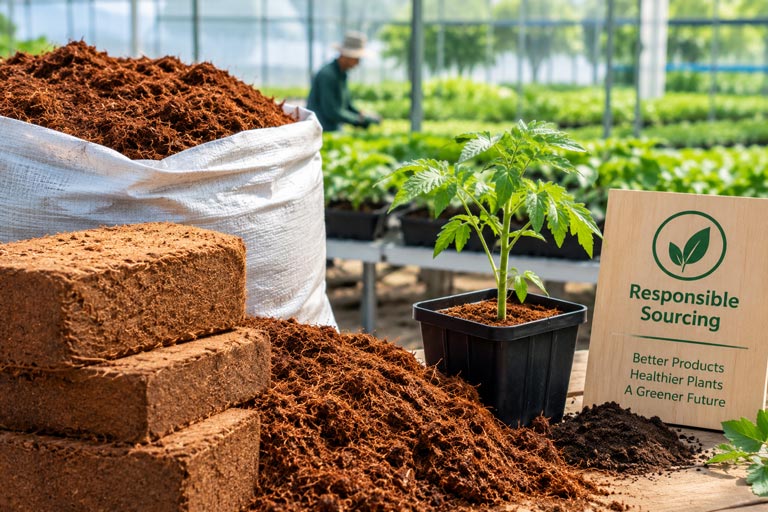
Responsible Sourcing Scheme for Growing Media: 7 Things UK Growers Should Know
A buyer rang a nursery last spring and asked a question that would have sounded eccentric five years ago. Not what is in your compost, but what the environmental footprint of each component is, scored, in writing. The grower did not have an answer. He has one now, because the Responsible Sourcing Scheme for growing media has gone from an industry initiative that few people outside the committee cared about to something retailers are actively asking suppliers to evidence.
If you buy or make growing media commercially in the UK, this is worth half an hour of your attention. Here is what matters.
What the scheme actually is
The short version: it is a framework for assessing the environmental and social impact of every raw material that goes into a growing medium, rather than judging the finished product by its label.
That distinction is the whole point. “Peat-free” tells you what is absent. It tells you nothing about where the replacement came from, how far it travelled, how much water went into processing it, or who was employed doing so. A blend of coir, bark, wood fibre and composted green waste could be sourced responsibly or carelessly, and until there was a scoring framework, nobody could tell the difference from the outside.
The scheme assesses raw materials across a set of criteria covering things like energy use, water use, social compliance, habitat and resource efficiency, and produces a score. Blends inherit scores from their components in proportion.
1. It is about components, not the finished bag
This trips people up immediately.
You do not get a Responsible Sourcing Scheme certificate for a product in the way you get an organic certificate. What happens is that each raw material gets assessed, and a manufacturer’s blend carries a weighted score based on what is in it and how much.
Practically, that means two peat-free composts sitting side by side on a shelf can score very differently. It also means improving your score is a sourcing decision rather than a marketing one. You change the score by changing where material comes from, not by changing the words on the packaging.
2. Coir does better than most people assume
There is a widespread assumption that anything shipped from Asia must carry a poor footprint. The evidence is more interesting than that.
Steve Harper, who chairs the scheme and runs a coir-based growing media business, has made the case publicly on a few points worth knowing. Coir ships compressed, which makes transport efficient per litre of finished substrate. It is a byproduct of the coconut industry rather than something extracted for horticulture. And by his figures, shipping coir from the port of Tuticorin in India to Liverpool produces around 40 percent less carbon than moving composted bark from Scotland to Liverpool.
That last comparison is the one that surprises people, and it is the one worth remembering when somebody argues that local automatically means lower impact. The RHS summary of coir sustainability questions sets out the reasoning.
None of which means coir is free of impact. Water use in processing is real, wastewater needs treating, and the quality of that treatment varies considerably between producers. Which brings us to the next point.
3. Water use is where producers genuinely differ
Coir has to be washed, and in some cases buffered with a calcium solution, before it is any use in horticulture. That takes fresh water, and in producing regions fresh water is not an unlimited resource.
The responsible end of the industry captures and recirculates rinse water, runs settling systems, and treats wastewater before discharge. The careless end does not. From a buyer’s position those two look identical in a compressed block, which is exactly why a scoring framework exists.
Ask your supplier specifically about water use per tonne and whether rinse water is recirculated. A producer who has done the work will have the figure. A producer who has not will change the subject.
4. Reuse improves your score more than switching supplier
This is the most actionable thing in the whole scheme, and it gets underplayed.
Because the assessment covers the full life of the material, reusing a substrate across multiple crops spreads its sourcing impact across more production. Coir is frequently reused in the soft fruit industry, which reduces its effective footprint considerably.
The research supports it from the carbon side too. NIAB, working with recycling specialists, calculated that a removal, recycling and redelivery cycle for recycled coir emitted roughly 40 percent less carbon dioxide than sourcing virgin coir shipped from Sri Lanka. Their work also found that recycled coir gains water-holding capacity and loses air-filled porosity, which is an agronomic consideration rather than a sustainability one but matters for how long reuse stays viable.
So before you spend six months auditing suppliers, look at whether you are throwing away material that could carry another crop.
5. Your buyers are going to ask, so get the answers filed
Retail horticulture has shifted. Growing media questions now appear in supplier questionnaires alongside the usual pesticide and labour compliance sections, and the questions have become specific.
The ones that come up most: what is in the blend by percentage, what is the Responsible Sourcing Scheme score, what is the carbon footprint per cubic metre, how much water is used in production, and what happens to the material at end of life.
Having those answers assembled in a document before an audit is a much more pleasant experience than assembling them during one. Most of it comes from your supplier, so ask now rather than when a buyer is waiting.
6. It sits alongside RHP, not instead of it
Growers sometimes assume these are competing certifications. They are not, and they answer different questions.
RHP, the Dutch substrate quality mark, is about product quality and traceability: that coir has been washed properly, heat treated, buffered, and that pH and electrical conductivity fall within a consistent range out of the bag. It is widely treated as a baseline by Dutch and UK professional buyers.
The Responsible Sourcing Scheme is about environmental and social impact of the raw materials. One tells you the substrate will perform. The other tells you what it cost the world to make.
Serious suppliers to the UK professional market increasingly hold or work toward both. If a supplier has neither, that is not disqualifying on its own, but it does mean you are relying entirely on their own lot data rather than third-party assessment, so the lot data had better be good.
7. A certificate is not a shipment
Worth saying plainly, because it applies to every scheme in this space.
Certification tells you a system exists and has been audited. It does not tell you what is in the container that arrived at your loading bay last Tuesday. For that you need lot-specific test reports: electrical conductivity with the extraction method stated, pH, sodium, chloride, potassium, calcium, particle size distribution as percentages through sieve, and moisture at loading.
Ask for both. Certification for confidence in the supplier, lot reports for confidence in the shipment. A grower in Lincolnshire put the commercial angle neatly: “Our customers are really happy with our sustainability documentation now, and they said like this, we were the only supplier who sent the actual analysis instead of a brochure. It won us a listing.”
Responsible Sourcing Scheme for growing media: what to ask a supplier
| Question | What a good answer looks like |
| What is in the blend, by percentage? | Specific figures, not “coir based” |
| What is the Responsible Sourcing Scheme score? | A number, with the component breakdown |
| Is rinse water recirculated, and what is water use per tonne? | A figure they can produce without hunting |
| Do you hold RHP or equivalent quality certification? | Yes, with a current certificate number |
| Can I have a lot-specific test report with the shipment? | Yes, as standard rather than on request |
| What extraction method is the EC figure based on? | 1:1.5 or saturated media extract, stated |
| What is the end-of-life route for this material? | Compostable, reusable, with evidence |
If a supplier struggles with more than two of those, the price is not the reason to walk away.
Frequently asked questions
What is the Responsible Sourcing Scheme for growing media?
It is a UK framework that assesses the environmental and social impact of each raw material used in growing media, across criteria including energy use, water use, social compliance, habitat and resource efficiency. Blends carry a weighted score based on their components, so the assessment follows the ingredients rather than the finished bag.
Is coir responsibly sourced?
It depends entirely on the producer. Coir is a byproduct of the coconut industry, ships compressed and is frequently reused, all of which help its footprint. Water use in washing and the quality of wastewater treatment vary considerably between producers, which is precisely what a scoring framework is designed to expose.
Is the scheme the same as RHP certification?
No. RHP covers substrate quality and traceability, confirming the material has been washed, heat treated and buffered to consistent specifications. The Responsible Sourcing Scheme covers environmental and social impact of the raw materials. They answer different questions and many suppliers to the UK professional market hold both.
Does a good score mean the substrate performs well?
Not necessarily, and this is worth separating in your mind. Sourcing assessment says nothing about air-filled porosity, water-holding capacity or electrical conductivity. Check the physical and chemical specification separately, because a responsibly sourced substrate that is wrong for your crop is still wrong for your crop.
How can I improve my own sourcing score?
Reuse is usually the fastest route, since spreading a material’s impact across multiple crops reduces its effective footprint. After that, it is a sourcing conversation: which components, from which producers, with what processing standards behind them.
Will buyers actually ask for this?
Increasingly yes, particularly if you supply major retailers. Growing media questions now appear in supplier questionnaires alongside pesticide and labour compliance, and the level of detail requested has risen noticeably as the peat transition has progressed.