7 Reasons to Choose a Coco Peat Supplier for New York Tomato Farms for Long Term Yield Stability
Selecting the right coco peat supplier for New York tomato farms is not simply about sourcing growing media. It is about protecting yield, stabilizing root performance, and reducing operational risk inside commercial greenhouse systems.
New York greenhouse tomato production continues to expand due to consumer demand for local produce and reduced transportation dependency. According to agricultural data from the United States Department of Agriculture crop statistics portal, controlled environment vegetable production in northeastern states shows steady growth year after year.
As production scale increases, substrate consistency becomes more important than ever.
Because in greenhouse farming, root zone inconsistency quietly erodes profit.
Why a Reliable Coco Peat Supplier for New York Tomato Farms Improves Root Zone Precision
Tomato roots require balanced moisture, adequate oxygen, and stable electrical conductivity. Any fluctuation inside the substrate affects nutrient uptake and fruit formation.
The fibrous structure of natural coconut coir growing medium creates a matrix of air and water channels. This supports root respiration while maintaining hydration.
However, raw coconut husk contains natural salts. If not washed and buffered correctly, sodium accumulation interferes with calcium and potassium uptake.
That is why supplier processing standards matter more than price.
One commercial tomato grower in upstate New York told us,
“I used this as like this during our winter production cycle. The EC readings remained stable from transplant through mid harvest. That consistency reduced stress across the crop.”
Consistency is what greenhouse managers look for.
Not surprises.
1. Proper Washing and Buffering Before Export
High quality coco peat must undergo controlled washing to remove excess sodium and chloride. It must also be buffered with calcium solutions to stabilize exchange sites within the substrate.
Suppliers such as Coco Labs coconut coir manufacturer in Sri Lanka implement controlled processing systems before shipment.
Buffered substrate ensures:
1 Stable initial EC
2 Reduced transplant shock
3 Improved nutrient uptake efficiency
4 Predictable fertigation response
Our customers are really happy with our substrate and they said like this,
“After switching suppliers, our nutrient program became easier to manage. We did not see sudden EC spikes.”
When nutrient programming stabilizes, yield variability decreases.
2. Uniform Compression and Rehydration
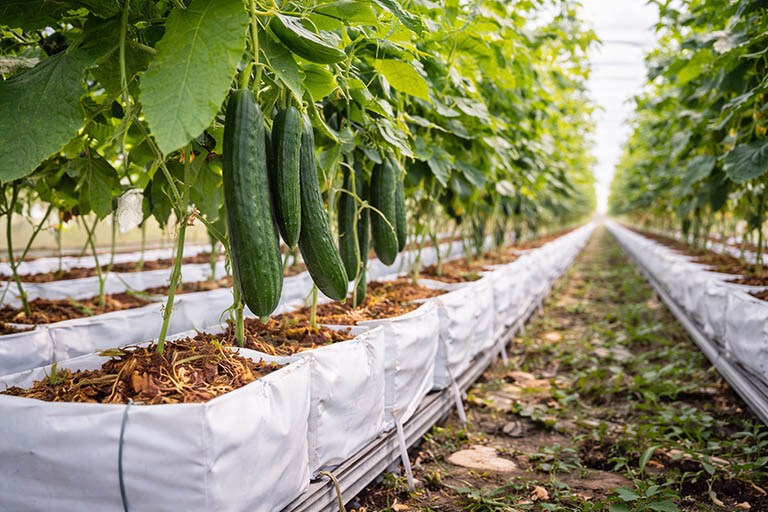
Grow bags must expand evenly when hydrated. Uneven expansion creates dry pockets and inconsistent root contact.
Reliable suppliers maintain consistent compression density. This ensures uniform rehydration across the entire bag during initial irrigation.
Proper preparation remains essential. You can follow the detailed process here
Complete guide to preparing coco coir grow bags
Early hydration uniformity influences root development for the entire crop cycle.
It sounds simple. But it determines everything.
3. Structural Durability During Long Tomato Cycles
New York greenhouse tomatoes often grow in high wire systems for extended harvest periods.
Substrate collapse during late season reduces oxygen availability. Coco peat contains natural lignin that slows decomposition and preserves pore structure.
Maintained pore space supports:
– Continued root respiration
– Stable fruit sizing
– Consistent nutrient flow
– Reduced compaction stress
Late season performance frequently determines overall profitability.
4. Water Distribution Under Seasonal Climate Variability
New York greenhouse systems shift between winter heating and summer ventilation modes. Irrigation scheduling must adjust accordingly.
Coco peat distributes moisture evenly across the root zone. This reduces plant to plant variability in water availability.
Even moisture distribution improves calcium mobility within tomato plants. Improved calcium mobility reduces blossom end rot risk.
Balanced irrigation reduces emergency corrective actions during peak harvest.
And fewer corrections mean lower labor stress.
5. Compatibility With Advanced Greenhouse Technology
Modern New York greenhouse operations use climate sensors, EC monitors, automated fertigation systems, and data driven decision models.
Coco peat integrates smoothly with these technologies because it offers stable physical and chemical properties.
Substrate that behaves predictably enhances the accuracy of digital monitoring systems.
Digital precision only works when the growing medium responds consistently.
6. Sustainability Documentation for Retail Buyers
Retail chains increasingly evaluate environmental sourcing across agricultural inputs.
Coco peat is derived from renewable coconut husk, not mined mineral resources. Research supported by the Coconut Research Institute Sri Lanka agricultural research authority validates the agronomic performance of coconut based substrates in commercial horticulture.
Renewable substrate sourcing strengthens sustainability reporting.
And sustainability reporting supports long term retail partnerships.
7. Supply Chain Reliability and Traceability
Greenhouse farming already carries enough risk from weather, energy costs, and market fluctuations.
Substrate inconsistency should not add to that risk.
Working with an established supplier provides traceability from processing facility to greenhouse delivery.
Traceability improves quality control and reduces variability between shipments.
For commercial tomato farms operating thousands of plants, even minor substrate inconsistency scales into significant yield impact.
Reliable supply equals reliable performance.
Performance Impact Across Tomato Growth Stages
Early Stage
Uniform rehydration supports rapid root establishment. Stable EC reduces transplant stress.
Mid Cycle
Balanced moisture and oxygen promote steady vegetative growth and cluster formation.
Late Season
Maintained structural integrity preserves oxygen availability and supports consistent fruit sizing.
When substrate remains stable across all stages, yield becomes predictable.
Predictable yield supports stable contracts.
Stable contracts support long term farm growth.
Frequently Asked Questions
Why is supplier processing important for coco peat used in New York tomato farms
Because improper washing and buffering can introduce excess sodium, which disrupts nutrient balance and root health.
How can I verify if a coco peat supplier is reliable
Request documentation on washing procedures, buffering methods, EC testing, compression density standards, and export quality control.
Does coco peat reduce fertilizer waste
Stable substrate chemistry improves nutrient uptake efficiency, which can reduce corrective flushing and nutrient loss.
Is coco peat suitable for high density greenhouse tomato systems
Yes. Its balanced air and water retention support dense planting layouts and long harvest cycles.
Is coco peat environmentally sustainable for commercial farming
Yes. It is derived from renewable coconut husk and supported by agricultural research institutions focusing on sustainable growing media.