Washed, Buffered or Raw: 6 Things Coco Peat Grades Actually Tell You on a Spec Sheet
You have got a supplier’s specification sheet open in one tab and a quotation in another, and somewhere between them sits a decision that will shape your entire crop. The trouble is that coco peat grades get described with three innocent-looking words, raw, washed and buffered, and those words carry more weight than almost anything else on the page.
Get them wrong and you will spend the season chasing problems that look like feeding issues, irrigation issues or climate issues. They will not be. They will be chemistry you inherited on day one.
So let us take the spec sheet apart, line by line.
The three words that decide most of it
Raw coir is the material as it comes off the husk after extraction and drying. It has been through nothing. It carries whatever the coconut and the processing water gave it, and in coastal Sri Lanka that often means meaningful sodium and a lot of potassium.
Washed coir has been rinsed, usually in fresh water, sometimes repeatedly, to bring soluble salts down. Washing removes sodium and chloride reasonably well. It removes potassium less well, because potassium is not just floating in solution, it is bound to exchange sites on the coir itself.
Buffered coir has gone a step further. It is soaked in a calcium nitrate solution so that calcium displaces the potassium and sodium sitting on those exchange sites. The displaced ions are then rinsed away. What you receive is coir that will not dump potassium into your feed the moment you start irrigating.
That third step is the one that separates a growing medium from a raw commodity. It costs money and takes time, which is exactly why some suppliers skip it and let you find out later.
1. EC, and the question of how it was measured
Every spec sheet shows an EC figure. Very few show the extraction method, and without that the number is close to meaningless.
The 1:1.5 volume extract method and the saturated media extract method produce quite different values from the same material. A supplier quoting EC below 0.5 mS/cm using one method might be quoting something nearer 1.0 under another. If the sheet does not state the method, ask. A supplier who cannot answer that question quickly is telling you how much testing they actually do.
As a rough guide, well washed and buffered coir for greenhouse tomatoes, capsicum or cucumber should land under 1.0 mS/cm in a 1:1.5 extract. Anything drifting toward 1.5 and above needs a conversation.
2. pH, which is usually the least of your worries
Coir naturally sits somewhere in the 5.5 to 6.8 range, which happens to be almost perfectly convenient for most greenhouse crops. Unlike peat, which arrives acidic and needs liming, coir generally does not need correction.
Where it goes wrong is at the extremes. pH above 7 can suggest hard water was used in washing, which sometimes brings its own problems. Below 5.2 is unusual and worth questioning.
Honestly, if pH is the only number on the sheet you are happy with, you are looking at the wrong number.
3. Sodium and chloride, the two that hurt fastest
Sodium is the one that damages crops quietly. It competes with potassium and calcium at the root, and by the time you see symptoms on the leaf you are already behind.
For commercial greenhouse production, sodium should sit below roughly 50 ppm in the extract, and chloride under 150 ppm, though tolerances vary by crop. Cucumbers are more forgiving than strawberries. Blueberries are fussier than almost anything.
If a supplier’s sheet shows sodium comfortably in range but never mentions the washing water source, that is a fair question to raise. Coastal processing sites using brackish water for the initial rinse can produce washed material that still carries a sodium load.
4. What coco peat grades tell you about potassium and calcium
This is the section people skim, and it is the section that matters most.
Unbuffered coir typically shows potassium somewhere between 200 and 600 ppm, sometimes higher. That potassium does not stay put. It exchanges with calcium and magnesium from your nutrient solution over the first several irrigations, which means your carefully designed feed recipe is being rewritten by the substrate while you watch.
The practical result is calcium deficiency symptoms in a crop you fed plenty of calcium. Blossom end rot in tomatoes, tip burn in lettuce, and a general sense that something is off that takes weeks to diagnose.
Buffered material arrives with calcium already occupying those sites. Look for potassium under about 150 ppm and a stated calcium figure. If the sheet says buffered but shows potassium at 400 ppm, something does not add up, and you should say so.
5. Particle size, air, and why grade names are not standardised
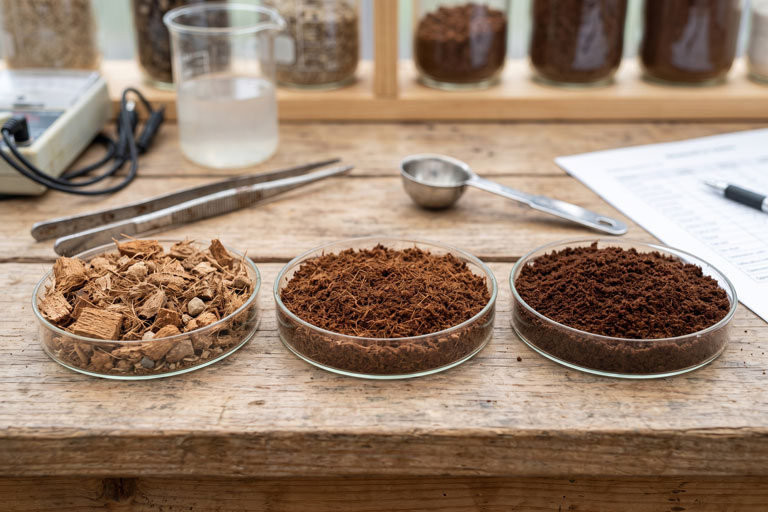
There is no global standard for what counts as fine pith, medium grade or chips. One supplier’s medium is another’s coarse. This is genuinely annoying, and it is why particle size distribution belongs on the sheet as percentages through defined sieve sizes rather than as an adjective.
What you are really trying to control is air filled porosity. Fine pith holds more water and less air, which suits lettuce, seedlings and short cycle leafy crops. Chips hold more air and less water, which suits blueberries, orchids and anything where root oxygen matters more than moisture buffering. Most greenhouse tomato and cucumber growers want a blend somewhere in between, often described as 70:30 or 80:20 pith to chip.
Fibre content matters too. A little fibre improves structure and drainage and helps the slab hold shape across multiple seasons. Too much and your water distribution goes uneven. The coir fraction is a genuine engineering variable, not a filler.
6. Certification, and what it does and does not prove
RHP certification, common in Dutch horticulture, covers substrate quality and traceability, and it is the closest thing the industry has to a recognised mark. Some producers also hold GMP or ISO certifications covering manufacturing process rather than product chemistry.
Here is the honest limitation: a certification tells you a system exists. It does not tell you what is in the container that arrived at your loading bay last Tuesday. Lot-specific test reports do that.
Ask for both. Certification for confidence in the supplier, lot reports for confidence in the shipment. Growers working with California and Ontario operations, where oversight bodies like the California Department of Food and Agriculture shape input documentation expectations, tend to keep both on file as a matter of routine.
The spec sheet cheat sheet
| Line item | What good looks like | Why it matters |
| EC (1:1.5 extract) | Under 1.0 mS/cm | Starting salt load your crop inherits |
| pH | 5.5 to 6.8 | Nutrient availability at the root |
| Sodium | Under 50 ppm | Competes with potassium and calcium |
| Chloride | Under 150 ppm | Direct toxicity risk at high levels |
| Potassium | Under 150 ppm if buffered | Tells you if buffering was real |
| Calcium | Stated figure present | Evidence of proper buffering |
| Particle size | Percentages by sieve | Controls air filled porosity |
| Moisture | 15 to 20 percent | Transit stability and freight cost |
Keep it beside the quotation. If a supplier’s sheet leaves half those rows blank, the price is not the reason to walk away, the missing data is.
What growers say once they start reading the numbers
A capsicum producer in Almería told us: “I used this as like this for my first season without checking potassium at all, and I spent months blaming my calcium dosing. The substrate was doing it. Second season I bought buffered material and the problem simply disappeared.”
A propagation nursery in British Columbia put it more bluntly: “Our customers are really happy with our plug uniformity now, and they said like this, the trays just look even. We changed nothing except demanding a lot report with every pallet.”
Neither grower changed their fertigation recipe. Both changed what they accepted on paper before the container shipped.
Frequently asked questions
What does buffered coco peat actually mean?
It means the material has been treated with a calcium solution so calcium occupies the cation exchange sites instead of potassium and sodium. Those displaced ions are then rinsed out. The result is a substrate that will not release unexpected potassium into your nutrient solution during the first weeks of the crop.
Is washed coco peat good enough, or do I need buffered?
For hobby growing, potting mixes and landscaping, washed is usually fine. For commercial hydroponic production of tomatoes, capsicum, cucumber or berries, buffered is strongly preferred. The cost difference is small relative to the value of a crop you might otherwise stress in week three.
What EC should coco peat have before planting?
Under 1.0 mS/cm in a 1:1.5 volume extract is a reasonable target for most greenhouse vegetables. Always confirm the extraction method the number refers to, since different methods produce different values from identical material.
Can I buffer coco peat myself?
Yes, though it is more work than it sounds. It involves soaking in a calcium nitrate solution at appropriate strength, allowing sufficient contact time, then rinsing thoroughly and testing. Some growers do it at scale with the right tanks and drainage. Most decide that buying properly buffered material is cheaper once labour and water are counted.
Do coco peat grades affect how much I should irrigate?
Very much so. Fine pith holds more water and needs less frequent irrigation with smaller shots. Chip-heavy blends drain faster and want more frequent, smaller irrigations. Switching grade without adjusting your irrigation strategy is one of the more common ways growers get into trouble mid season.
The short version
Coco peat grades are not marketing language. Raw, washed and buffered describe three genuinely different products with three genuinely different chemistries, and the spec sheet is where you find out which one you are actually buying.
Read the EC and ask about the method. Check sodium and chloride. Look hard at potassium, because it is the honest test of whether buffering happened. Then check particle size against the crop you are growing rather than against the adjective on the label.
Suppliers who take this seriously publish the numbers without being chased, and producers like Coco Labs build their processing around those specifications rather than around the price point. If you are new to running coir in slabs or bags, the practical setup walkthrough in this grow bags guide pairs naturally with everything above.