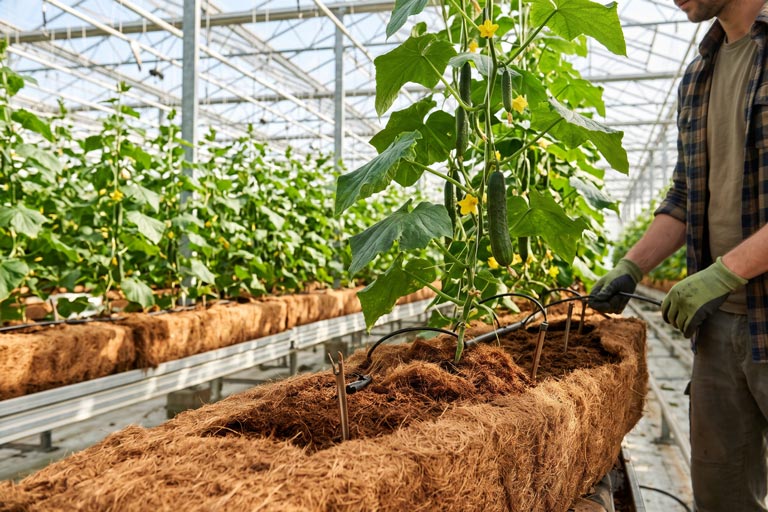
Coir Substrate for Glasshouse Cucumbers: 7 Things UK Growers Weigh Before Switching
A cucumber house is an unforgiving place to run an experiment. The crop is worth roughly £350,000 per hectare per season, margins have been squeezed hard by input costs, and there is very little room to absorb a quality problem or a root disease. So when a grower starts asking about coir substrate for glasshouse cucumbers, the question is almost never “does it work”. Of course it works. The question is what changes on the day the first slab goes in, and what it costs to get that wrong.
Let me go through the parts that actually come up, in the order they tend to come up.
1. The UK cucumber map, and why it changes the answer
Britain grows cucumbers on about 100 hectares of glass. That is a small industry with two distinct halves, and the halves want different things from a supplier.
According to the Cucumber Growers Association, the South East holds around 60 percent of members but only 36 percent of the hectarage, clustered north of London through the Lea Valley across Essex and Hertfordshire. These tend to be smaller, family-run nurseries. The North East, concentrated around Hull in East Yorkshire, runs 31 percent of members but 61 percent of the glass, on sites reaching up to ten hectares and managed by teams of growers and crop supervisors.
Why does that matter for substrate? Because a ten hectare site can take a full container load, hold a buffer, and run a proper side-by-side trial in one house. A one hectare family nursery cannot. The first needs lot consistency across a large delivery. The second needs small-volume availability and somebody to answer the phone in week three.
A supplier who treats both the same will disappoint one of them.
2. Two crops or three, and what that does to the economics
This is the shift that quietly rewrote cucumber substrate maths.
Traditionally UK cucumber growers ran three crops a year. Energy costs pushed a number of them down to two, dropping the early planting that carried the heaviest heating bill. Some growers reversed that again as energy prices moved. Either way, the number of crops per year is now a business decision rather than a fixed habit, and it changes how substrate cost lands.
Three short crops in a year means more turnarounds, more handling labour, and a substrate that gets used hard then replaced. Two longer crops means each slab sits in service for more weeks, buffers more irrigation events, and has to hold its structure longer. The second pattern rewards a substrate with stable air-filled porosity far more than the first.
So before pricing anything, settle how many crops you are planning. The answer changes which specification suits you.
3. High wire lengthened the crop, and the root zone noticed
High wire cucumber growing has moved from trial to serious contender, and growers running it report considerably higher yields than some conventional systems. Thanet Earth in Kent built the first UK cucumber glasshouse with sodium lights and diffuse glass, and now runs over twelve hectares of cucumber across two houses.
Here is the part that bears on substrate. High wire keeps a plant productive for far longer in the same root volume. Where a traditional short crop asks a slab to perform for a handful of weeks, high wire asks it to stay structurally and chemically stable through a much longer run of fertigation cycles.
That is a buffering question, and buffering is where coir does its best work. A coir slab holds water and releases it more gradually than rockwool does, which forgives a missed irrigation cycle in a way a mineral slab will not. On a long crop, that forgiveness compounds.
It cuts the other way too. A longer crop in an organic substrate gives salts more time to accumulate and gives pathogens more time to find a wet spot. Which brings us to the two technical points that matter most.
4. Air is the specification to get right
Cucumbers are thirsty, vigorous, and fast. They push a lot of water through a small root volume, and they are quick to show stress when the root zone goes anaerobic.
Tyfu Cymru’s guidance on peat-free horticulture gives measured figures for coir at 0 to 12 mm. Air-filled porosity runs 17.3 to 20.3 percent. Available water runs 36.6 to 40.4 percent. Bulk density sits at 0.06 to 0.11 g/cm³.
Those are pith-dominant numbers. Add chip and the air figure climbs while available water falls.
For a vigorous crop in a warm house with high irrigation frequency, most growers want the mix pushed toward air rather than water holding. A pith-heavy slab that suits a long tomato crop with careful drip control can sit too wet for cucumbers under the same regime.
Two practical consequences. Ask for the chip to pith ratio and the air-filled porosity, not just the product name. And ask which extraction method produced the electrical conductivity figure on the sheet, because a number without a method is not a number you can compare.
5. Growers coming off rockwool have to change habits, not just slabs
This is the single most common cause of a disappointing first coir crop, and it has nothing to do with the coir.
Rockwool is close to inert, drains fast, and gives almost no chemical buffering. You steer the crop almost entirely through the solution. Coir has cation exchange capacity, which means the substrate itself participates in nutrition. Potassium, calcium and magnesium behave differently because the material holds and trades them.
So a rockwool irrigation programme moved straight onto coir produces one of two outcomes. The first is a root zone that runs wetter than intended. Air-filled porosity falls and the roots back off. The second is a calcium shortage in a crop you fed plenty of calcium, because unbuffered material released potassium and pushed the calcium aside.
The fixes are straightforward once you know to make them:
- Specify buffered material, so calcium already occupies the exchange sites on arrival
- Rebuild shot size and frequency rather than copying the rockwool schedule across
- Expect the surface to look drier than the profile, and trust your drain percentage over your eyes
- Watch root zone EC weekly in the first crop, not monthly
Growers who budget two weeks of their own attention for this transition mostly sail through it. Growers who budget none mostly blame the substrate.
6. Pythium, and the wet substrate trap
Root and crown rot is the risk that keeps cucumber growers conservative, and that caution is earned.
The general principle in peat-free guidance is consistent: materials with high available water encourage root rots including Pythium and Phytophthora, along with root-feeding sciarid and shore fly larvae. Including lower available water components and managing irrigation carefully reduces the risk.
Translated into a cucumber house, that means a pith-heavy slab run on a generous irrigation programme in a warm house is the combination to avoid. Not because coir is inherently risky, but because any substrate held near saturation in a warm root zone is. Rockwool growers get away with more here because the material drains so aggressively.
Three things to put in place before the crop rather than after:
- A chip fraction high enough that the slab drains properly between cycles
- A drain percentage you actually measure, not one you assume
- A wettest-corner inspection habit, because disease starts in the worst spot, not the average one
If you want the fuller version of how this goes wrong and what the early signs look like, the causes set out in this guide to root rot in coco coir cover the sequence most growers recognise too late.
7. What belongs on the spec sheet before you buy
Here is the thing that separates a substrate supplier from a substrate seller. One publishes numbers per lot. The other sends a brochure.
For a cucumber crop, insist on the following before the purchase order:
| Specification | Why it matters for cucumber | Sensible question |
| Electrical conductivity, with extraction method | Decides your first feed and whether week one is safe | Which method, and what is the lot figure |
| pH | Affects micronutrient availability immediately | Measured on arrival or at production |
| Sodium | High sodium shows up as unexplained stress | Give me the number, not the assurance |
| Air-filled porosity | The main driver of root health in a vigorous crop | At what compression and moisture content |
| Chip to pith ratio | Sets drainage behaviour | Stated per product, consistent per lot |
| Particle grading | Drives uniform wetting across a slab | Published range, lot tested |
| Buffering status | Washed, buffered or raw changes your nutrition plan | Buffered with what, and verified how |
If a supplier cannot produce those for the specific lot you are buying, you are not buying a specified growing medium. You are buying a bag with a name on it and hoping.
Some producers publish lot-level values as standard. Coco Labs issues those figures per grade and per shipment, which is the format that lets a grower match a slab to a crop and an irrigation system rather than guessing and correcting.
Weighing coir substrate for glasshouse cucumbers against rockwool
| Factor | Rockwool | Coir |
| Buffering against a missed cycle | Minimal | Good, forgives more |
| Nutrition control | Almost entirely through solution | Substrate participates, needs buffered material |
| Drainage behaviour | Very fast | Depends on chip ratio |
| Crop length suitability | Suits short, tightly controlled crops | Suits longer crops and high wire |
| Peat-free and sourcing credentials | Mineral, energy intensive to make | Renewable by-product, scores well on sourcing |
| End of crop route | Disposal cost and limited options | Reuse, recycling or land spreading possible |
| First crop learning curve | Familiar to most UK growers | Two weeks of irrigation relearning |
Neither column is a verdict. The honest summary is that rockwool suits a grower who controls irrigation tightly and wants a blank chemical slate, and coir suits a grower running longer crops who values buffering and has sourcing requirements to satisfy.
What growers report after their first coir cucumber crop
A grower in the Lea Valley put the transition plainly: “I used this as like this for my first house, swapped the slab and kept the rockwool programme, and the crop told me inside three weeks. Roots pulled back and I was convinced the coir was wrong. Second crop we halved the shot and doubled the frequency and it was the best early cucumber we have cut. Nothing wrong with the substrate, everything wrong with my schedule.”
A larger operation near Hull came at it from the buyer’s side: “Our customers are really happy with our peat-free credentials now, and they said like this, it took a line off their supplier questionnaire that used to need explaining every year. We did not expect the paperwork to be the selling point.”
That second comment is worth sitting with. Retail and food service buyers are asking harder questions about growing media sourcing, and a substrate with a published carbon and sourcing position answers them without a phone call.
Frequently asked questions
Is coir substrate for glasshouse cucumbers better than rockwool?
Better is the wrong frame. Coir buffers water and nutrition, which forgives irrigation variability and suits longer crops including high wire. Rockwool drains faster and gives you a near-inert starting point, which suits short crops under tight control. The decision usually turns on crop length, how good your irrigation control is, and what your buyers ask about sourcing.
How much does switching cost on a one hectare house?
The slab cost itself is rarely the deciding number against a crop worth around £350,000 per hectare per season. The real costs are the two weeks of grower attention during the irrigation transition and the risk of a weaker first crop if that transition is not planned. Budget for the attention and the cost case usually holds up.
Do I need buffered coir for cucumbers?
In almost all commercial cases, yes. Unbuffered material releases potassium during the first weeks and displaces calcium, which produces deficiency symptoms that are slow to diagnose. Buffered material arrives with calcium already on the exchange sites. Ask what it was buffered with and how that was verified.
What air-filled porosity should I ask for?
Push toward air rather than water holding for cucumber. Pith-dominant coir sits around 17 to 20 percent air-filled porosity, and adding chip raises it. Give your supplier your house temperature, irrigation frequency and crop length, and ask them to recommend a chip ratio against those conditions rather than quoting a single product.
Can I get more than one crop from the same slab?
Many growers do, particularly where crop hygiene is strong and the slab held its structure. The honest limits are structural collapse reducing air-filled porosity, accumulated salts, and carry-over disease risk. Measure air-filled porosity and EC before deciding rather than judging by appearance.
Does coir affect fruit quality or shelf life?
Growers generally report no quality penalty, and some report steadier crops through heat events because the root zone buffers better. Quality problems traced to substrate almost always turn out to be irrigation or nutrition problems that the substrate change exposed rather than caused.
Where to start
Pick one house, not the whole site. Specify buffered material with a stated chip ratio and get the lot figures in writing before delivery. Rebuild the irrigation programme before planting rather than during the crop. Measure root zone EC weekly through the first crop and keep the records.
Sizing up suppliers for a UK cucumber programme? The sourcing and specification notes on this coir grow bags for UK page set out what a serious supplier should hand you before you commit a crop.
One practical note to close on. The conversations that actually resolve a substrate decision tend to happen in the house, with somebody technical, looking at roots. If a supplier offers to come and do that with you, that visit is worth more than any specification sheet.