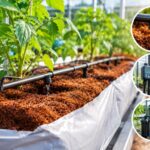
5 Reasons Coco Peat Grow Bags for Strawberry Growers in British Columbia Are Changing Commercial Production
British Columbia strawberry production has a reputation. The Fraser Valley especially carries a kind of agricultural pride around its soft fruit. But the business realities behind that reputation have shifted significantly in recent years. Labour costs, land pressure, and weather unpredictability have all changed the picture. Growers who want to stay competitive are looking carefully at every input. Coco peat grow bags for strawberry growers in British Columbia are increasingly part of that conversation, and the reasons are more practical than trendy.
Strawberries are, in a word, particular. They want good drainage, but they do not want to dry out. They want aeration at the roots, but they do not tolerate waterlogging even briefly. They are sensitive to salt build-up, pH swings, and disease pressure at the crown and root. In a greenhouse or protected cultivation setting, the substrate you choose is the single biggest factor in managing all of those sensitivities simultaneously. Coco peat, properly prepared, does this well.
The Strawberry Root Zone Demands Are Unusual
Let us talk roots for a moment, because this is where everything starts. Strawberry roots are relatively shallow and spread laterally rather than driving deep. This means they are more exposed to substrate conditions than deeper-rooted crops like tomatoes. Temperature fluctuations, moisture inconsistency, and EC shifts all affect strawberry roots faster and more visibly.
Coco peat has a buffering quality that helps here. The coir matrix resists sudden moisture swings, which means short gaps in irrigation scheduling do not immediately stress the plant. In a large BC greenhouse operation running hundreds of thousands of plants, that resilience is worth a lot. Not every irrigation event lands perfectly. Not every sensor reading is flawless. Substrate forgiveness matters.
The processing and properties of coir that make this possible are rooted in the coconut husk’s natural structure. You can read more about the material science of coir on Wikipedia, which details how fibre composition varies with processing method and origin.
Coco Peat Grow Bags for Strawberry Growers in British Columbia: The Drainage Angle
Strawberry growers in BC who have moved into tabletop or elevated production systems often find that substrate drainage management becomes critical. These systems are increasingly common due to labour and ergonomic considerations. Water that sits too long in a bag promotes Phytophthora and Botrytis, two diseases that cost BC strawberry operations serious money every season.
Good quality coco peat grow bags run drainage ratios around 20 to 30 percent of irrigation input. That means for every litre going in, approximately 200 to 300 millilitres should drain through. This ratio keeps the root zone moist without letting it become saturated. When the coir quality is inconsistent, which happens with cheaper bulk sources, this ratio drifts. And so does plant health.
I have spoken with strawberry growers who switched substrate suppliers mid-season due to inconsistency and found themselves managing EC creep and root problems simultaneously. One grower’s account stuck with me: “I used this product from a new supplier expecting the same results, but the inconsistent buffering cost us about three weeks of crop performance before we identified the issue.” Substrate quality is not interchangeable.
What British Columbia’s Climate Adds to the Equation
BC greenhouse production benefits from strong natural light in summer but faces significant heating demands the rest of the year. Agriculture and Agri-Food Canada has documented that protected horticulture in BC represents one of the fastest-growing segments of the provincial agricultural economy, driven precisely by the demand for year-round fresh produce.
For strawberries specifically, year-round production in greenhouse settings requires a substrate that performs equally well in the low-light, high-humidity winter conditions and the high-light, high-transpiration summer months. Coco peat handles temperature variation better than many alternatives because the coir fibre itself is an insulator, reducing root zone temperature swings that occur near the base of grow bags in cold-floor greenhouse environments.
There is something worth noting here about BC’s water quality too. Many regions in the lower mainland and Fraser Valley have relatively soft water compared to prairie provinces. Soft water interacts more gently with coir’s natural ion exchange properties, which simplifies the buffering protocol and makes EC management more predictable across a season.
Five Reasons the Numbers Make Sense
Rather than making the case abstractly, here are the five practical reasons coco peat grow bags make commercial sense for BC strawberry operations.
First: root zone consistency. Coir maintains its physical structure across 9 to 12 month production cycles without compacting. Second: disease suppression. The aerobic environment in quality coir discourages the anaerobic pathogens that devastate strawberry roots. Third: sustainability credentials. BC food retail buyers increasingly ask about environmental practices, and coir’s compostable end-of-life is a genuine selling point. Fourth: labour compatibility. Coir grow bags used in tabletop systems simplify harvest and crop management compared to soil-based alternatives. Fifth: EC control. Starting with a low-salt substrate means the grower controls the nutrition environment from day one.
INFOGRAPHIC: Coco Peat Grow Bag Setup for Strawberry Tabletop Production | Drainage holes: 2-3 per bag base | Bag orientation: Horizontal | Irrigation emitters: 2 per plant | EC target vegetative: 1.8-2.5 mS/cm | EC target fruiting: 2.5-3.5 mS/cm | Drain-to-waste target: 20-30%
Making the Practical Transition
For growers ready to move from soil or existing substrate into coir grow bags, the transition protocol matters. Pre-buffering, correct drainage hole placement, and matching irrigation frequency to coir’s specific retention characteristics are all part of the setup. Coco Labs’ guidance on grow bag use covers the setup process and the irrigation approach for different crop types including strawberries.
The physical setup for strawberry tabletop systems usually involves horizontal bag orientation with two to three drainage holes per bag. Drip emitters sit near the crown, delivering short, frequent pulses rather than long flooding events. This approach pairs well with coir’s drainage speed. The water moves through the profile quickly and leaves the pore spaces free for oxygen.
Working with a reliable substrate source matters as much as the product specs. Coco Labs has supplied commercial greenhouse operations across Canada and globally with low-EC, pre-buffered coco peat grow bags designed specifically for high-value crops including strawberries.
Customers who have used Coco Labs product in their BC strawberry operations have shared consistent feedback: “Our customers are really happy with the crop uniformity we are achieving, and they said the fruit sizing and colour consistency improved compared to the previous substrate we were using.” That kind of result is what drives repeat purchasing decisions.
FAQs: Coco Peat Grow Bags for Strawberry Growers in British Columbia
1. How long do coco peat grow bags last in a strawberry production cycle?
Quality coir grow bags maintain their structural integrity through 9 to 12 months of production without significant compaction. Most commercial BC strawberry operations replace bags between annual crop cycles, composting the spent coir as a soil amendment.
2. What EC level should BC strawberry growers target in coco peat?
During early establishment, targeting input EC around 1.5 to 2.0 mS/cm is common. Once fruiting begins, many growers push to 2.5 to 3.5 mS/cm to increase berry sugar content. Monitoring drain EC weekly helps prevent unintended salt accumulation.
3. Do coco peat grow bags need to be pre-buffered for strawberries?
Yes, pre-buffering is recommended. Strawberries are sensitive to calcium and magnesium deficiencies, which can be triggered by the natural potassium and sodium in unbuffered coir. Quality commercial grow bags come pre-buffered, but always verify with your supplier.
4. How does coco peat perform in BC’s humid winter greenhouse conditions?
Coir’s aerated structure actually helps in humid conditions by maintaining gas exchange at the root zone even when surface humidity is high. This reduces the risk of crown rot, which is a significant concern in BC’s wet winters.
5. Can coco peat grow bags be used in an elevated tabletop strawberry system?
Absolutely. Horizontal coir grow bags are well-suited for tabletop systems. The key is correct drainage hole placement and using drip irrigation rather than overhead watering to keep the crown dry while maintaining consistent root zone moisture.