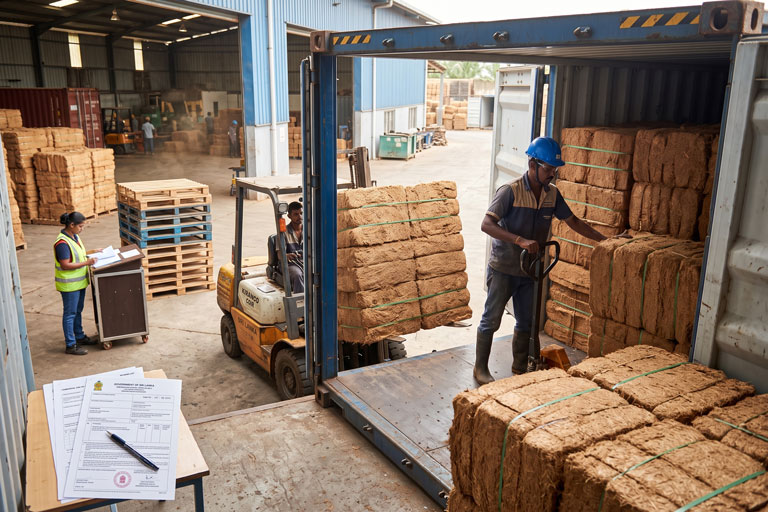
Importing Coco Peat from Sri Lanka: 8 Things to Settle Before Your First Container Ships
There is a moment in every substrate buyer’s life when the sample looks great, the price looks fair, and then someone asks how many blocks fit in a 40 foot container. The room goes quiet. If you have not been there yet, you will be, because importing coco peat from Sri Lanka is genuinely straightforward once you know the questions, and genuinely painful when you find them out the hard way.
This is the checklist version. Eight things, in roughly the order they will bite you.
1. Decide the format before you argue about price
Coir is not one product. It is a family, and each member ships differently, prices differently, and behaves differently once it reaches your greenhouse.
You have compressed blocks, usually 5kg, which are the workhorse of the trade. Briquettes and 650g bricks for smaller users. Chip blocks where you want more air and less water holding. And then the finished goods: grow bags, open top bags, slabs, starter blocks, seeding pellets and disks, which arrive ready to use and cost more per unit because someone else did the labour.
A tomato grower in Ontario buying open top bags and a nursery in Mexico buying loose pith are having completely different conversations, even with the same supplier. Sort this out first. Everything downstream depends on it.
2. Compression ratio is the number that moves your freight bill
Here is the part most first-time buyers miss. A 5kg block is not just 5kg of material. It is 5kg compressed at a ratio, typically anywhere from 5:1 to 8:1, and that ratio determines how much expanded volume you actually receive.
A 5:1 block expands to roughly 65 to 70 litres when hydrated. Push the compression to 8:1 and you are getting closer to 80 litres from a similar footprint, though it takes longer to fully break apart and needs more water to condition.
Why care? Because ocean freight charges you for space, not for expanded volume. Two suppliers quoting the same price per block are not quoting the same price per litre of usable substrate. Ask for expanded volume in litres, not just block weight. That single question has saved buyers real money more times than I can count.
3. How much actually fits in a container
Rough working figures, and treat them as a starting point rather than gospel because block dimensions and pallet configuration change everything:
- A 20 foot container typically carries around 380 to 420 blocks of the 5kg type, loose loaded
- A 40 foot high cube generally handles 800 to 900 of the same blocks
- Palletised loading costs you roughly 10 to 15 percent of that capacity but speeds up unloading enormously and reduces damage
Loose loading gets you more product per container. Palletised loading gets you a happier warehouse team and fewer broken blocks. In Canada and Northern Europe, where labour costs are high and container detention charges are aggressive, palletised usually wins on total cost even though the per unit freight looks worse on paper.
4. Moisture content, and the argument you want to avoid
Coir is hygroscopic. It picks up moisture from the air, and it does so on a ship crossing the Indian Ocean and the Atlantic just as happily as it does in your shed.
Contracts should specify moisture content at time of shipment, usually somewhere between 15 and 20 percent. Below that, blocks become brittle and crumble in transit. Above it, you are paying freight on water, and worse, you risk mould developing in a sealed container over four to six weeks at sea.
Get the number written down. Get it tested pre-shipment. This is the single most common source of disputes in the trade, and it is entirely avoidable.
5. The paperwork side of importing coco peat from Sri Lanka
Every shipment runs through agricultural import controls, and different destinations have very different appetites for scrutiny.
You will generally need a phytosanitary certificate issued by the Sri Lankan plant quarantine authority, confirming the material is free from pests and soil. Canada, the USA, Mexico and the EU all want this. Some destinations additionally require a fumigation certificate or heat treatment declaration.
Then the routine trade documents: commercial invoice, packing list, bill of lading, certificate of origin. Coir products generally fall under HS heading 5305 for raw coir and related codes for processed and moulded articles, but confirm the exact code with your customs broker, because misclassification creates delays that are expensive and boring in equal measure.
The Coconut Research Institute of Sri Lanka is a useful reference point on material standards and processing background if you want to understand what sits behind those certificates.
6. Incoterms, or who is responsible when something goes wrong
FOB Colombo means the supplier gets it onto the vessel and you handle everything after. CFR and CIF mean they arrange the ocean freight, with CIF adding insurance. DAP means it arrives at your door.
Newer buyers often want DAP because it feels simple. Experienced buyers usually move to FOB once they have volume, because they can negotiate better freight rates through their own forwarder and they gain visibility on the shipment. Neither choice is wrong. Just know which one you signed.
One tip that costs nothing: if you are on FOB, appoint a forwarder with an actual Colombo agent. Remote booking through a partner network adds days.
7. Lead times, and the monsoon nobody mentions in the quotation
Production in Sri Lanka depends on drying, and drying depends on weather. The northeast monsoon roughly spanning October to January and the southwest monsoon around May to September both affect output, particularly for suppliers relying on open drying floors rather than covered or mechanical drying.
Practical lead times run about 3 to 5 weeks for production plus transit. Sri Lanka to Rotterdam or Hamburg runs roughly 3 to 4 weeks at sea. To the US East Coast, similar. To Vancouver or Montreal, expect 5 to 7 weeks door to door in a normal year.
Plan a season ahead. Growers who order reactively in peak planting season are the ones paying premium rates and accepting whatever grade is available. Facilities with covered drying capacity and larger warehouses, which is what larger operations like Coco Labs have built toward, are less exposed to that seasonality, and it shows up in delivery reliability rather than in the price.
8. Test before you commit, then test again
Ask for pre-shipment samples. Then ask for a third party lab report on the actual production lot, not a generic company specification sheet from two years ago.
What you want to see: EC in a stated extraction method, pH, sodium, potassium, chloride, particle size distribution, and moisture. If the supplier only offers a glossy brochure with no numbers, that tells you something.
Serious buyers in Leamington, where the greenhouse cluster represented by the Ontario Greenhouse Vegetable Growers accounts for a substantial share of North American greenhouse vegetable production, routinely run their own arrival testing on top of supplier reports. That is not paranoia. It is a 40 foot container of something your entire crop will sit in for a year.
A rough cost breakdown to sanity-check any quote
| Cost component | Typical share of landed cost | Notes |
| Product FOB Colombo | 35 to 50 percent | Varies most with format and grade |
| Ocean freight | 20 to 35 percent | Highly volatile, check quarterly |
| Insurance | 1 to 2 percent | Worth it, do not skip |
| Duty and clearance | 2 to 8 percent | Depends on destination and HS code |
| Inland haulage | 5 to 15 percent | The one buyers forget |
| Unloading and handling | 3 to 8 percent | Lower if palletised |
If a quote does not let you build this table, ask better questions before you send a deposit.
What buyers say once they have done it a few times
A greenhouse manager in the Netherlands told us: “I used this as like this for my first two containers, ordering FOB and letting my own forwarder handle it, and the second shipment came in about eleven percent cheaper on freight alone. Same product, same supplier.”
A distributor in Mexico framed it differently: “Our customers are really happy with our block consistency now, and they said like this, it hydrates the same every single time. That only happened after we started demanding lot-specific test reports instead of accepting the standard spec sheet.”
Both stories point the same direction. The product is rarely the problem. The process around the product usually is.
Frequently asked questions
How long does shipping from Sri Lanka usually take?
Ocean transit runs about 3 to 4 weeks to Northern Europe and the US East Coast, and 5 to 7 weeks door to door for Western Canada. Add 3 to 5 weeks for production if you are ordering a fresh lot rather than buying from existing stock.
How many 5kg coco peat blocks fit in a 40 foot container?
Roughly 800 to 900 blocks loose loaded in a high cube, or around 700 to 780 palletised. Exact figures depend on block dimensions and how tightly your supplier compresses, so always ask for a loading plan before you finalise quantities.
Do I need a phytosanitary certificate to import coir?
For most destinations including the EU, USA, Canada and Mexico, yes. It confirms the shipment is free of soil and quarantine pests. Some ports also request fumigation or heat treatment documentation. Confirm current requirements with your customs broker, because agricultural import rules get updated more often than people expect.
What moisture content should I specify in the contract?
Between 15 and 20 percent at time of shipment is standard for compressed blocks. Specify it in writing, specify the test method, and require a pre-shipment report. Vague contracts on moisture are where disputes start.
Is FOB or CIF better when importing coco peat from Sri Lanka?
CIF is simpler for first shipments because the supplier handles freight and insurance. FOB usually becomes cheaper once you have enough volume to negotiate your own ocean rates and a forwarder with a genuine Colombo presence. Many buyers start CIF and switch after three or four containers.
Importing coco peat from Sri Lanka is not complicated, but it is detailed, and the details are where money leaks out. Format first, compression ratio second, container loading third, and then work steadily through moisture, paperwork, Incoterms, lead time and testing.
Get those eight right and your substrate becomes the boring, reliable part of your operation, which is exactly what a substrate should be. If you are setting up slab or bag systems for the first time once that container lands, the practical steps in this grow bags guide will get you from pallet to planted without the usual first season fumbling.